

Here’s a question I get asked almost every week: Do I really need a tour guide in Egypt, or can I figure it out myself?
As someone who has been guiding travelers through Egypt for over 15 years — through the Valley of the Kings at sunrise, past the souk vendors in Khan el-Khalili, and into corners of Abu Simbel that most tourists walk right past — I can give you an honest answer. Not a sales pitch. An actual answer.
The short version: it depends on what you want to do, and where.
If you’re heading to Sharm el-Sheikh for a beach holiday or spending a weekend exploring modern Alexandria, you can manage perfectly well on your own. But if you’ve come to Egypt to understand what you’re looking at — to stand in front of the hypostyle hall at Karnak Temple and actually feel the weight of 3,400 years — then yes, a knowledgeable guide changes everything.
In this article, I’ll walk you through the real benefits of hiring a guide, the situations where you genuinely don’t need one, what good guides cost, and how to avoid bad ones. By the end, you’ll know exactly what’s right for your trip.
When You Genuinely DON’T Need a Tour Guide in Egypt
Before I make the case for hiring a guide, let me be direct about the exceptions — because the honest answer includes them.
You probably don’t need a guide if you’re:
- Staying at a beach resort in Hurghada, Sharm el-Sheikh, or Marsa Alam — these are tourist-friendly areas designed for independent travelers
- Exploring modern Cairo neighborhoods like Zamalek, Maadi, or the Corniche for contemporary food and culture
- Spending time in Alexandria at its seafront and modern city center
- A very experienced independent traveler on a tight backpacking budget
You almost certainly do need a guide if you’re:
- Visiting major archaeological sites — the Pyramids of Giza, Valley of the Kings, Karnak Temple, Abu Simbel, Saqqara, Dendera
- Traveling with family, elderly parents, or young children
- Short on time and can’t afford logistical missteps
- Visiting for the first time and want to actually understand what you’re seeing
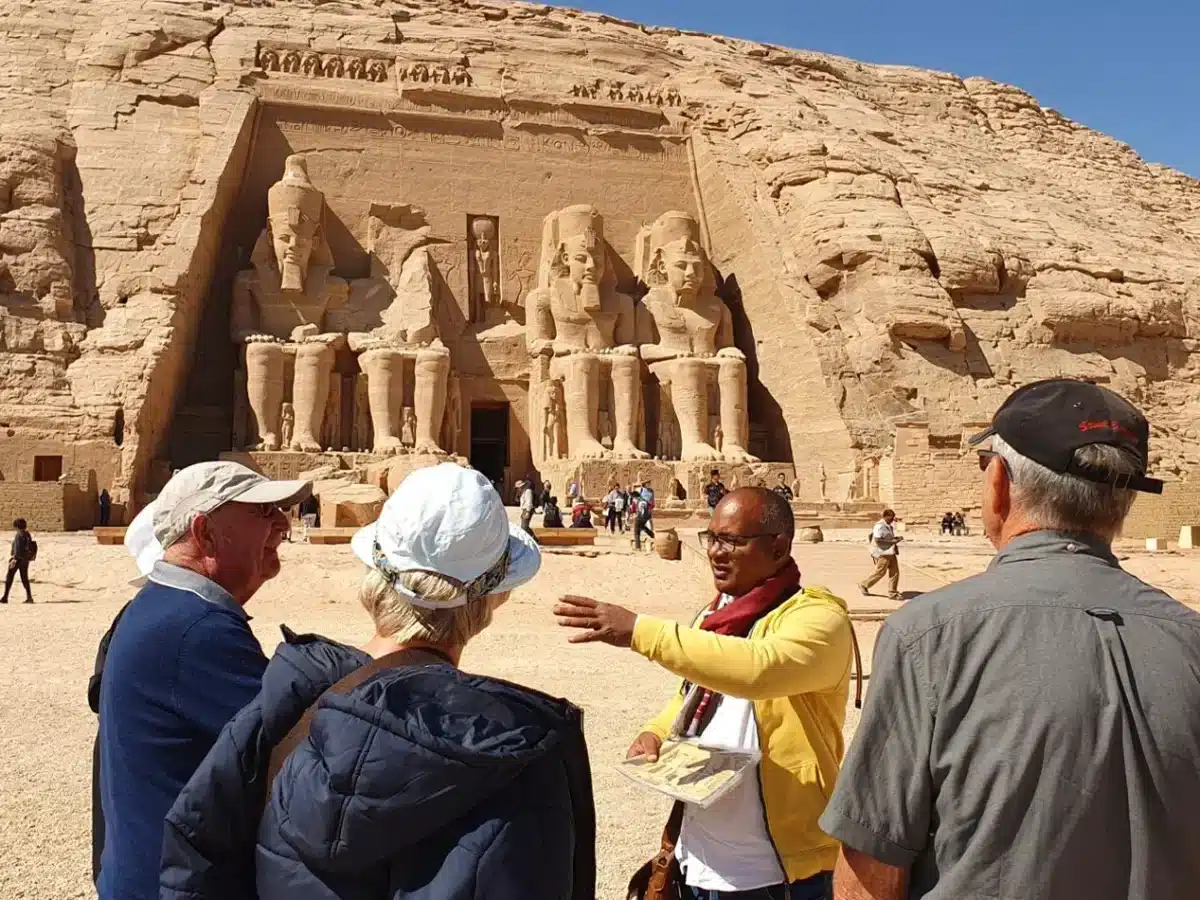
The reason archaeological sites are different comes down to something simple: Egypt’s history is extraordinarily layered. You can spend 45 minutes walking through Karnak Temple reading the posted English signs and still leave with no real understanding of what happened there, who built what, or why any of it matters. A good guide — and I mean a properly trained, Ministry of Tourism-licensed Egyptologist guide — turns that same 45 minutes into something you’ll talk about for years.
7 Real Benefits of Hiring an Egyptian Tour Guide
These aren’t abstract talking points. There are things I’ve watched matter, trip after trip.
- You actually understand what you’re looking at
Walk into the Grand Egyptian Museum without context, and it’s beautiful but bewildering — 100,000 artifacts across 5,000 years of civilization. A licensed Egyptologist guide doesn’t just point at things; they connect what’s in front of you to everything else you’ve seen, building a picture of how Egyptian civilization evolved. That connection is almost impossible to replicate with an audio guide or a Wikipedia article on your phone.
- Vendor situations become manageable
Every first-time visitor to the Giza plateau asks about vendor pressure. Yes, vendors approach tourists at major sites. A good guide manages these interactions quietly and respectfully — you stay comfortable and focused on the experience rather than bracing for the next approach. This alone is worth a significant amount of stress reduction.
- You hit sites at the right time
Knowing when to arrive at the Valley of the Kings to avoid the tour bus crowds, or which entrance at Karnak means you skip the longest queues — these are things that only come from having done it hundreds of times. I’ve watched travelers wait 40 minutes in the wrong line at a site they spent $4,000 to visit. Time is your scarcest resource in Egypt.
- Logistics stop being your problem
Transportation in Cairo is chaotic in ways that catch even experienced travelers off guard. Getting from Luxor to Dendera without your own car is doable but complicated. A guide working within an organized Egypt tour package means you can focus on experiencing Egypt while someone else handles the logistics.
- Cultural nuance doesn’t get lost
Egypt’s social customs aren’t obvious to outsiders. Knowing how to behave at a mosque, how to navigate a traditional market without being drawn into awkward situations, and when photography is welcome and when it isn’t — a guide makes you a more respectful and more comfortable traveler. For more on this, our Cultural Etiquette in Egypt guide covers the essentials.
- Hidden access you’d never find alone
Not hidden in a mystical sense — hidden in the sense of “that small alabaster workshop where the craftsman has been working for 30 years” or the tea house that no tour group ever visits. Local guides have relationships in the places they work. That access is real.
- Safety in unfamiliar territory
Egypt is generally safe for tourists, and for a thorough breakdown, our “Is Egypt Safe to Visit” article covers the full picture. But a guide who knows the city — which routes to take, when a neighborhood is busier than usual, how to navigate any situation that arises — adds a layer of confidence that matters, especially for first-time visitors.
Do You Need a Guide for Specific Sites? A Quick Reference
Not every site in Egypt has the same level of complexity. Here’s a practical breakdown:
| Site | Guide Recommended? | Why |
|---|---|---|
| Pyramids of Giza | Yes — strongly | Without context, the history is invisible. Vendor situation also benefits from a guide. |
| Valley of the Kings | Yes — strongly | Complex tomb system, hieroglyphic content, hidden story connections across tombs |
| Karnak & Luxor Temples | Yes | One of the world’s most layered archaeological complexes — overwhelming without guidance |
| Abu Simbel | Yes | Remote location + extraordinary historical significance |
| Grand Egyptian Museum | Yes — for first visit | Scale requires curation; you can’t see everything meaningfully |
| Saqqara & Dahshur | Yes | Often overlooked; a guide makes the evolution from mastaba to pyramid legible |
| Khan el-Khalili | Optional | Great to explore alone; a guide adds cultural commentary but isn’t essential |
| Hurghada / Sharm el-Sheikh | No | Resort areas; independent travel is easy |
| Modern Alexandria | No | City navigation is intuitive; guided tours are nice but not necessary |
Private Tour Guide vs. Group Tour: Which Is Right for You?
The choice isn’t just about budget — it’s about what kind of experience you want.
Private guides give you full flexibility. If you want to spend two hours at a single tomb rather than 20 minutes at six of them, you can. If you want to stop for lunch at a specific restaurant or skip a site that doesn’t interest you, that’s your call. Private Cairo day tours or Luxor day tours are built exactly around this flexibility. The tradeoff is cost — private tours run higher.
Group tours give you a social dimension and a significantly lower per-person cost. You meet other travelers, and the experience of sharing a moment at the Pyramids with people from different countries has its own appeal. The tradeoff is a fixed schedule — you move at the group’s pace, not yours.
If this is your first trip and you have the budget, private is almost always the better choice for the major archaeological sites. If you’re traveling on a tighter budget, our Budget Egypt Tours section shows what’s achievable without sacrificing the key experiences.
How Much Does a Tour Guide Cost in Egypt?
Guide costs are often more reasonable than first-time visitors expect:
| Guide Type | Duration | Average Cost (USD) | Best For |
|---|---|---|---|
| Private Guide (Cairo or Luxor) | Full Day | $40–$80 | Flexible, personalized sightseeing |
| Private Guide | Half Day | $25–$50 | Museum visits, focused site tours |
| Group Tour Guide | Full Day | $15–$30 per person | Budget-conscious travelers |
| Specialized Egyptologist Guide | Full Day | $60–$100 | Deep historical immersion |
| Site Guide (Temples, Museums) | 1–2 Hours | $10–$20 | Standalone site explanations |
Beyond the guide fee, factor in entrance tickets, transportation, meals, and a tip — tipping is customary in Egypt, and a guide who has given you a quality day deserves around $10–$20 at the end.
The thing worth keeping in mind: a good guide at the Karnak Temple for $60 will provide a deeper experience than spending $200 on the wrong hotel room. It’s one of the highest-return investments in Egyptian travel
How to Find a Good Guide – and Avoid a Bad One
Not all guides are equal. Egypt’s tourism industry has excellent guides, and people will approach you outside a site and offer their services for $5. Here’s how to tell the difference.
A legitimate, quality guide will:
- Hold a license from the Egyptian Ministry of Tourism and Antiquities — these are issued after formal university training in Egyptology or archaeology
- Be arranged through a reputable, established travel company (not approached at a site entrance)
- Discuss your interests before the tour begins and adapt accordingly
- Have documented reviews from past travelers
Red flags to watch for:
- Guides who approach you unsolicited outside major sites
- Pressure to visit specific shops or papyrus galleries (guides earn commissions there)
- No verifiable booking confirmation or company affiliation
- Vague credentials or inability to answer specific historical questions
When you book through a company like EgyVacations, guide selection and vetting are handled by the company. Every guide working on our Egypt tours holds a Ministry of Tourism certification and has been verified by our operations team.
Day Trip vs. Full Week: Does the Guide Need Change?
For a one-day visit — say, arriving from Hurghada for a day at the Pyramids of Giza — a single site guide or a half-day private guide is ideal. These are covered well by our Egypt Short Breaks options.
For a week or more, the guide relationship deepens. The same guide over multiple days learns what you find fascinating, moves at your natural pace, and builds a narrative arc across sites that makes the entire trip feel coherent rather than a sequence of disconnected visits. This is what our Egypt Vacation Packages are built around — not just booking sites, but building a journey.
Alternatives to a Full Guide: When Going Solo Makes Sense
If a private guide doesn’t fit your budget or travel style for every day, there’s a middle path that works well for many travelers:
- Hire a guide only for the major archaeological sites (Valley of the Kings, Karnak, Giza) and explore urban areas independently
- Use audio guides at larger museums — the Grand Egyptian Museum has quality audio options
- Join a small group tour for specific days while staying independent on others
- Visit local markets like Khan el-Khalili on your own — the experience of navigating a traditional bazaar, tasting Egyptian street food, and getting slightly lost in the lanes is something a guided tour can actually diminish
For practical preparation, our Best Time to Visit Egypt guide and Egypt Packing List will help you arrive ready.
FAQ: Do You Need a Tour Guide in Egypt?
Do I need a guide at the Pyramids of Giza?
A guide is strongly recommended at Giza. The site is large, the history is layered, and vendor interactions at the plateau are much more manageable with a guide present. You can enter without one, but the experience is significantly different.
Is Egypt safe to visit without a tour guide?
Egypt is generally safe for tourists — see our detailed safety guide for the full picture. Traveling without a guide in major cities and resort areas is common and manageable. For archaeological sites, safety isn’t the main concern — understanding what you’re seeing is.
What is a licensed tour guide in Egypt?
A licensed Egyptian tour guide has completed a formal university program in Egyptology, archaeology, or tourism studies and has been registered with the Egyptian Ministry of Tourism and Antiquities. Licensed guides wear ID badges and can provide credentials if asked. Always book through a reputable operator to ensure your guide holds this certification.
Can I visit Egypt completely independently?
Yes. Independent travel in Egypt is possible, especially in resort areas and modern cities. For first-time visitors focused on ancient sites, it’s genuinely limiting — not because you can’t enter sites, but because the historical complexity is very difficult to navigate without expert context.
How do I avoid a bad tour guide in Egypt?
Book through a registered tour operator rather than hiring someone at a site entrance. Ask about the Ministry of Tourism licensing. Check reviews from past travelers. A quality guide will welcome questions about their background and experience.
Final Word
Egypt rewards preparation. The travelers who leave genuinely moved by what they’ve experienced are almost always the ones who had a knowledgeable guide walking through the sites with them — not because they couldn’t have managed on their own, but because understanding deepens everything.
Whether you choose a full private Egypt vacation package, a single guided day at the Pyramids, or a Nile cruise with expert commentary along the way, the goal is the same: come home knowing you didn’t just see Egypt — you understood it.
If you have questions about whether a guide makes sense for your specific itinerary, reach out through our Tailor Your Tour page, and we can help you work it out.
