

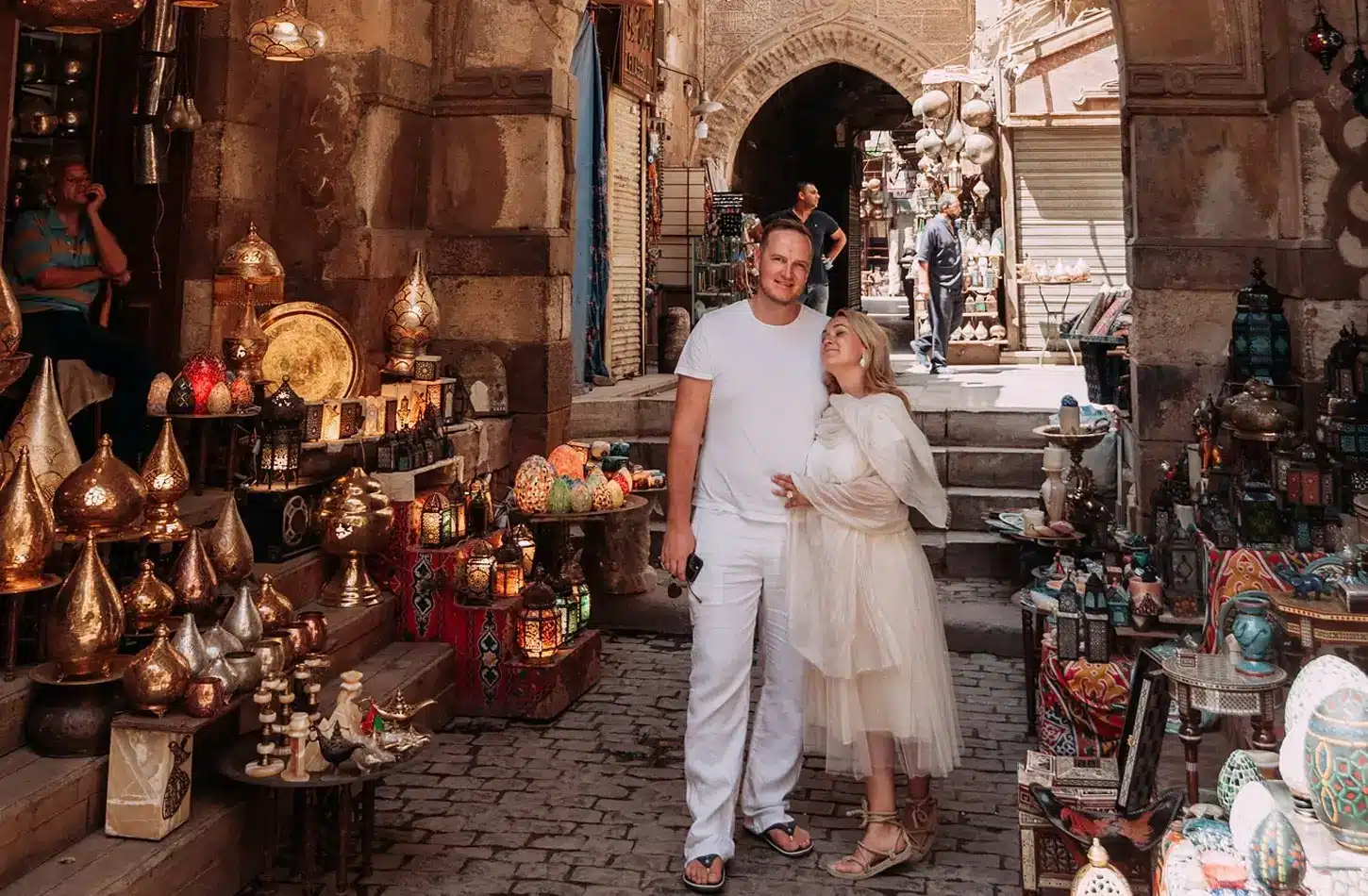
QUICK ANSWER
Khan el Khalili is a medieval bazaar district in the heart of Islamic Cairo, established in 1382 CE during the Mamluk era. Spanning a labyrinth of more than 40 alleyways across several square kilometres, it is Egypt’s most famous market and one of the oldest continuously operating bazaars in the world. Entry is free. Open daily from approximately 10:00 AM to midnight, with most shops closed on Fridays during midday prayer. Best times to visit: early morning (9:00–11:00 AM) for calm browsing, or after 5:00 PM for atmosphere. During Ramadan, the bazaar is at its most extraordinary after Iftar.
There is a version of Khan el Khalili that most visitors see — and a version that most visitors miss entirely.
The one they see is the first 200 meters from where the tour buses stop: rows of plastic pyramids, machine printed scarves, Pharaohs made in China, and sellers who have mastered in decades how to rip customers off even before they realise what they’re dealing with. This area is not wrong – it’s there to sell, but it’s virtually unrelated to the real market behind it.
‘Walking through the real alleys of Khan el Khalili for more than fifteen years now’, Yasser Shoaib, licensed Egyptian guide and an Egypt travel expert at Egy Vacations explains, ‘The bazaar punishes haste and rewards patience. It’s the tourists who come in hurry, who buy whatever they find at the first stall that end up taking away with them overpaid souvenirs and the feeling of being at some kind of theatre rather than something authentic’. This guide offers you the way to the real market.
Khan el-Khalili — Key Facts
| Fact | Detail |
|---|---|
| Founded | 1382 CE by Mamluk Emir Jarkas al-Khalili |
| Location | Al-Hussein Square, Islamic Cairo — 30.0472°N, 31.2620°E |
| UNESCO listing | Part of Historic Cairo World Heritage Site (1979) |
| Size | More than 40 alleyways across several sq km |
| Entry fee | Free |
| Opening hours | Daily ~10:00 AM – midnight (individual shops vary) |
| Friday closure | Most shops close 11:30 AM – 1:30 PM for Friday prayer |
| Best time of day | 9:00–11:00 AM (quieter) or after 5:00 PM (atmospheric) |
| Best days | Saturday–Thursday; avoid Friday midday |
| Ramadan hours | Extended — most vibrant after Iftar (~7:00 PM onwards) |
| Getting there | Taxi or Uber to Al-Hussein Square; nearest metro: Al-Shohadaa (15-min walk) |
| Safety | Generally safe; tourist police present; standard pickpocket awareness applies |
| Languages spoken | Arabic primarily; English widely understood among vendors |
| Currency | Egyptian Pounds (EGP); some vendors accept USD at poor rates — pay in EGP |
| ATMs | Available nearby at Al-Hussein Square; bring cash for the bazaar itself |
What Is Khan el Khalili? History of the Bazaar
Origins: The Fatimid Palace and the Black Death
The area in which Khan el Khalili was located had been home to the eastern palace of the Fatimid Caliphate, one of Cairo’s two grand palaces of the medieval period and home to the caliph and his court from 969 CE onwards. It became the trading center it is known as when, after Sultan Saladin of the Ayyubid dynasty took control of the region from the Fatimids in 1171 CE, the palace ceased being used by the royal family.
The establishment of the bazaar as we know it occurred in 1382, when Emir Jarkas al-Khalili, a Mamluk official, erected a caravanserai, or inn, on the location. This time is significant because it was shortly after the effects of the plague epidemic that had devastated the population of Egypt from 1340 to 1380 CE, killing about a third of the people there. The bazaar was part of Sultan Barquq’s reconstruction efforts to restore commerce and lure the merchant caravans, laden with spices, silk, and gold from Africa, Asia, and the Arabic-speaking nations, on which Cairo’s economy depended.
Throughout the centuries to come, the bazaar would evolve into an area that extended far from the initial khan of al-Khalili. In Ottoman times, it emerged as a place where gold and spices were exchanged. It was in 1511 that Sultan Qansuh al-Ghouri refurbished most of the bazaar in its current architecture. The name “Khan el Khalili,” which at first applied to only one structure, was eventually used for the whole bazaar.
Wondering when to plan your Egyptian adventure? Read our complete guide to the Best Time to Visit Egypt and discover the ideal seasons, weather, crowds, and travel tips for an unforgettable trip.
Naguib Mahfouz and the Literary Bazaar
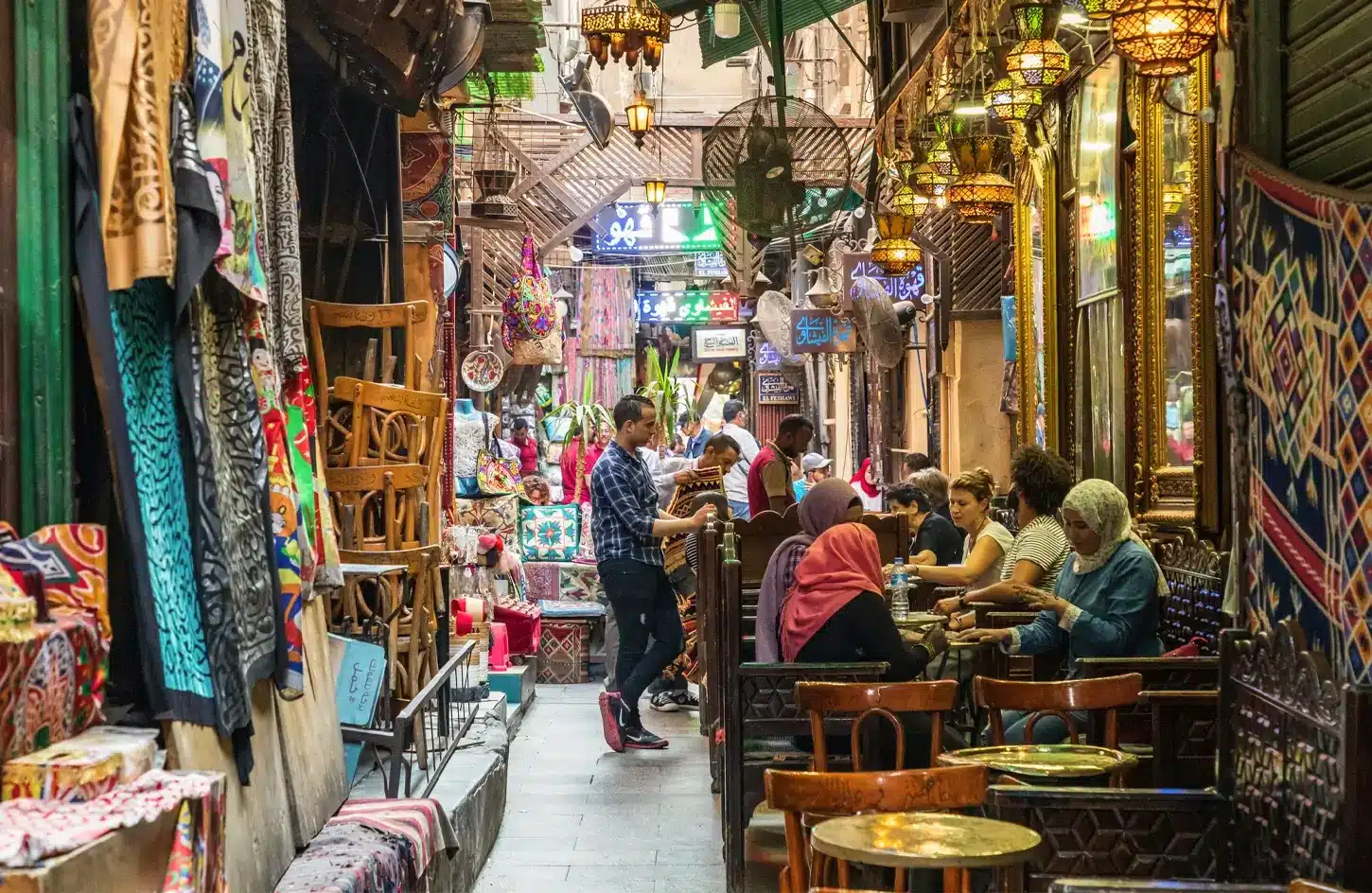
Khan el Khalili is woven into modern Egyptian literature as thoroughly as into medieval trade. Naguib Mahfouz — Egypt’s only Nobel Prize winner in literature — set his Cairo Trilogy and his novel Khan el Khalili itself in these streets, using the bazaar’s alleyways as the physical and moral landscape of Cairo’s 20th-century middle class. El-Fishawy Café, which has been serving tea continuously since 1797, was Mahfouz’s regular haunt for decades. The café’s worn wooden tables and tarnished mirrors feel less like décor than like sediment — the residue of 229 years of conversation.
The Two Khan el-Khalilis: Tourist Surface vs. the Real Market
Understanding this distinction is the single most useful thing this guide can give you.
The Tourist Surface (First 200 Metres)
The main entrance alleyway from Al-Hussein Square is the most photographed part of the bazaar and, in terms of genuine Egyptian craft, among the least interesting. Stalls here stock:
- Plastic and resin pyramids, Sphinx figurines, and pharaonic busts — virtually all manufactured in China.
- Machine-printed ‘papyrus’ on banana leaf — not actual papyrus, which is made from a specific reed and costs more to produce.
- Scarves and textiles with Egyptian imagery that are factory-produced in East Asia.
- Alabaster pieces that are often synthetic resin rather than genuine alabaster.
This may not be a scam because you are not getting worthless goods as in the case of buying a refrigerator magnet. However, if you come to Khan el Khalili with the aim of buying genuine crafts from Egypt, then you are definitely ending up with the same things that you can get at an airport gift shop.
THE FIRST RULE OF KHAN EL-KHALILI
Do not buy anything in the first 200 metres from Al-Hussein Square. Walk through without stopping. The real spice market, gold souk, copper workshops, and perfume bazaar are deeper inside. Come back to this section at the end if you want generic souvenirs — they will still be there, and you’ll know by then what things should actually cost.
The Real Bazaar (Where to Go Instead)
Just keep walking along the tourist strip until the nature of the stalls begins to change. It will become obvious because the pyramids and scarves will give way to sacks of spices, working copper workshops, marked goldsmiths, and perfume dealers with glass flacons and brass tools for weighing. This is the part of the bazaar that has really been making money for six centuries.
Yasser’s tour route through the Khan El-Khalili: come in from Al-Hussein Square, pass the tourist stalls, take your first right after the point where the spice market begins, and spend at least 30 minutes in the spice and perfume area before heading back to the gold souk. From there everything else can be seen.
Planning to explore Egypt’s vibrant capital? Read our complete Cairo Travel Guide for the best attractions, local tips, transportation advice, and must-visit landmarks.
What to Buy at Khan el Khalili — and What to Avoid
The Gold Souk — The Most Honest Part of the Market
This may seem contradictory, but the truth is that the gold souk happens to be the most transparent market place in the whole bazaar. Gold sells by weight based on the current market price – which is available immediately right there on your cell phone. The only item that is subject to bargaining is the ‘making charge’ – which is basically the price of labor from the gold craftsman who makes the engraving/shape of your choice.
What people love buying in Khan el Khalili is the cartouche – your own name engraved in hieroglyphic style within an oval pendant made either of gold or silver. It is done within half an hour up to an hour and the quality of work is real. Silver cartouches cost between 800-1500 Egyptian Pounds per item depending on its size while the price of gold cartouches is based on the daily price of gold plus making charge.
💡 HOW TO VERIFY GOLD
Look for hallmark stamps on all gold pieces: 18k gold shows ‘750’, 21k shows ‘875’, 24k shows ‘999’. Sterling silver shows ‘925’. Any reputable goldsmith will show you the stamp without hesitation. If a seller cannot or will not show you the hallmark, walk away.
The Spice Bazaar
The spice market, located next to the main area for the bazaars, is one of the most sensory places to visit — bags of cumin, coriander, cardamom, karkadeh, nigella, turmeric, and saffron stacked up to waist level, the air redolent with complex scents. The spices are reasonably priced when compared to Western costs and the quality of the well-established traders is excellent.
- Best to buy: cumin, coriander, dried hibiscus for karkadeh tea, black seed, and mixed ras el-hanout blends.
- Saffron: buy here but verify — genuine Egyptian saffron threads should be deep red with a slight orange tip. If it’s uniformly orange or smells more floral than earthy, it may be dyed safflower. Expect to pay EGP 200–400 per gram for genuine saffron.
- Packaging: ask the merchant to bag spices in sealed packets rather than open bags for transport.
Looking for the perfect Egyptian souvenir? Explore our guide to The Best Markets in Egypt: Where to Shop for Souvenirs and discover the top bazaars, local handicrafts, spices, jewelry, and unique gifts to take home.
The Perfume Souk
Essential oils form an important part of Egypt’s history, and the Khan el Khalili perfume market sells both pure essential oils and attars (non-alcohol perfumes) that can be created according to the customer’s preference. The oils that should be bought at the market are pure and include: oud, amber, jasmine, and sandalwood. When buying oils, make sure you ask for the pure oil and not a mixture.
The distinction to know: ‘Egyptian musk’ as sold in tourist stalls is almost always a synthetic fragrance with a minimal natural component. Pure oud oil is expensive worldwide — if it’s priced similarly to a cheap scarf, it isn’t pure oud.
Copper & Brass Workshops
There are still some small workshops in the backstreets of Khan el Khalili that make items out of hammered copper and brass such as trays, lanterns, coffee sets, and decorative plates. These are among the best items to buy as crafts. The prices may be bargained but they are not high; it does take time to make these and the craftsmen value the interest you take in their work.
If the item is hand-hammered and not machine pressed, there will be some unevenness in the design and hammer marks will be visible on the back of the item.
What to Skip
- ‘Antique’ Pharaonic scarabs, statuettes, or ushabti figures from bazaar stalls — genuine antiquities cannot legally be sold in Egypt and the overwhelming majority of ‘antique’ items are modern reproductions, often well-made but not ancient
- Machine-printed ‘papyrus’ — buy genuine papyrus from verified papyrus institutes in Cairo rather than the bazaar if this matters to you
- Any ‘genuine’ perfume or essential oil priced similarly to common goods — pure essential oils are expensive by definition.

How to Haggle at Khan el Khalili
Bargaining is expected in the bazaar. Not haggling at all is considered mildly odd rather than polite — vendors build negotiation into their opening prices. But effective haggling is not aggressive; it is conversational.
- Start at 40–50% of the first price quoted for general souvenirs and copper goods. For gold, do not counter the gold weight price — only negotiate the making charge.
- The strongest move in negotiation is walking away slowly. A significant number of ‘final prices’ have a further discount available when the buyer heads for the door.
- Drink tea if offered. Accepting tea creates a social exchange that actually makes negotiation easier, not harder — it shifts the interaction from transactional to relational. You are under no obligation to buy after accepting tea.
- Know what you want to pay before you open the conversation, not after. Having a target price makes walking away easier and signals to experienced vendors that you are not a first-timer.
- EGP prices are always better than USD or EUR prices. Paying in foreign currency almost always means paying an unfavourable exchange rate. Draw cash in EGP from ATMs near Al-Hussein Square before entering the bazaar.
💡 REFERENCE PRICES (June 2026)
Copper tray (medium, hand-hammered): EGP 400–800. Brass lantern (medium): EGP 300–600. Cotton galabiya: EGP 200–500. Silver cartouche pendant: EGP 800–1,500. Spices per 100g: EGP 30–150 depending on type. Karkadeh (dried hibiscus) 200g bag: EGP 60–100. These are reasonable paid prices after negotiation — not starting prices.
Where to Eat & Drink in and Around Khan el Khalili
El-Fishawy Café — 229 Years and Counting
The El-Fishawy coffee shop was established in 1797, a year prior to the French conquest of Egypt, and has been open since, day and night on many occasions. Naguib Mahfouz used to write there for many years. Its décor consists of layers of mirrors, hanging lamps, mashrabiya latticeworks, and old-fashioned wood furniture telling a story of history rather than just reflecting it.
Order: mint tea (chai na’na), coffee (ahwa), or freshly squeezed lemon juice (aseer laymoun). Shisha (hookah) is provided and commonly smoked. There is little food served in this café; this is a café in a classical way where people come to sit, drink, watch, and converse. It is definitely worth the more expensive prices, due to the nature of tourism. Better sit indoors than on pavement tables.
Naguib Mahfouz Restaurant
The name of the restaurant, inspired by the Nobel Prize winner, is the most trustworthy full-meal restaurant located in the area of bazaar – Egyptian cuisine, such as koshari, molokhia, grilled meat and mezze, served in a cozy and air-conditioned atmosphere. The restaurant is quite expensive, even by local standards, and obviously targeted at tourists, but the food is really tasty and its location near the bazaar allows you to take a rest there during the day.
Street Food Around Al-Hussein Square
The streets around Al-Hussein Square serve up some of the best street food in Cairo: ta’amiya (Egyptian falafel) freshly fried and served in bread, koshari from the koshari stalls, freshly squeezed sugar cane juice (aseer asab), and seasonal fruits. The prices are a fraction of what you pay at a restaurant. Eat where the food is being freshly cooked.
No trip to Egypt is complete without trying its authentic cuisine. Read our Traditional Egyptian Food guide to learn about the most popular dishes, desserts, and traditional drinks loved by locals.
Nearby: Combining Khan el Khalili with Islamic Cairo
Khan el Khalili sits at the heart of one of the most concentrated clusters of medieval Islamic architecture anywhere in the world. A half-day visit can reasonably include:
- Al-Hussein Mosque (immediately adjacent): One of the most revered sites in Sunni Islam in Egypt, believed to house the head of the Prophet’s grandson Imam Hussein. Non-Muslims may visit the exterior and the square; interior access is restricted at prayer times.
- Al-Muizz Street (5 minutes’ walk): The main spine of medieval Cairo, lined with Mamluk and Fatimid monuments — mausoleums, madrasas, sabil-kuttabs (public water dispensaries), and wikala (merchant inns). The street is pedestrianised and most beautiful in the late afternoon.
- Al-Azhar Mosque (3 minutes’ walk): One of the oldest universities in the world, founded 970 CE. Non-Muslim visitors are welcome outside prayer times; dress modestly and remove shoes at the entrance.
- Wikala al-Ghouri (10 minutes’ walk): A restored 16th-century Ottoman merchant inn, now a centre for traditional crafts and occasional folkloric performances. One of the best-preserved examples of a wikala in Cairo.
- Cairo Citadel (20 minutes’ walk or short taxi): The medieval fortified complex begun by Saladin in 1176, containing the Mohammed Ali Mosque — Cairo’s most recognisable skyline element — and the Military Museum. Separate entrance ticket required.
💡 IDEAL HALF-DAY ITINERARY
Enter Al-Azhar Mosque at 9:00 AM (before crowds). Walk north to Khan el Khalili through the back alleys — 10 minutes. Spend 30 minutes in the spice and perfume market. 30 minutes in the gold souk. Walk Al-Muizz Street south toward the Citadel (optional taxi for the final stretch). Return to Khan el-Khalili for El-Fishawy tea at 5:00 PM as the evening atmosphere builds.
Khan el Khalili During Ramadan
If your Egypt trip coincides with Ramadan, and you have the option to visit Khan el Khalili in the evening, do not miss it.
Ramadan bazaars take on an air that no other month can conjure up. Star-shaped lanterns, known as fanous lamps in Egypt, decorate the medieval streets in abundance. They create an atmosphere of lit streets that make them look like something out of medieval times. The aroma of spices and food gets stronger after the Iftar meal, when the whole neighborhood eats together at once and fills up the streets after Iftar until midnight and beyond.
People come from all over the city to have iftar in Al-Hussein Square. Long lines of people sit and eat in a communal space without being acquainted. The recital of the Quran goes on in mosques for the rest of the night. The coffee shops become occupied immediately after iftar. Suddenly, the streets that were deserted during daytime become filled with thousands of people, dressed up in their best clothes and playing games and running around.
The last ten days of Ramadan are the most intense, and they are also very special. Should there be some leeway for the time of the travel, it would be wise to schedule the trip to Cairo during the final ten days of Ramadan in order to have a unique experience.
Discover how Ramadan transforms Egypt with festive evenings, traditional celebrations, and vibrant local culture. Read our complete Ramadan in Egypt guide before your visit.
💡 RAMADAN PRACTICAL NOTES
Many shops and restaurants close during the day and reopen at Iftar. Plan to visit from Iftar onwards (check the exact time for your travel dates). Dress more conservatively than usual — long sleeves and covered legs are appropriate. Eating, drinking, or smoking in public during daylight hours is considered disrespectful to those who are fasting. Accept Iftar invitations from locals if offered — this is genuine hospitality, not a prelude to a sale.
Practical Information for Visitors (2026)
| Detail | Information |
|---|---|
| Entry fee | Free |
| Opening hours | Daily approx. 10:00 AM – midnight (individual shops vary widely) |
| Friday prayer closure | ~11:30 AM – 1:30 PM; most shops close; mosques very busy |
| Best time of day | 9:00–11:00 AM (calm) or 5:00 PM+ (atmospheric) |
| Best days to visit | Saturday–Thursday; Friday afternoon is the most crowded and most closures |
| Getting there by taxi/Uber | Ask for “Al-Hussein Square” or “Khan el-Khalili” — 20–40 min from central Cairo; EGP 100–200 |
| Getting there by metro | Al-Shohadaa station (Line 1/2 interchange) — 15-min walk through historic streets |
| Currency | Egyptian Pounds (EGP). Bring cash; card readers are rare in the bazaar itself |
| ATMs | Available at Al-Hussein Square before you enter |
| What to wear | Modest clothing recommended — covered shoulders and knees for both men and women |
| What to carry | Small cross-body bag or secure money belt; minimal cash; leave valuables at hotel |
| Photography | Generally welcomed; always ask before photographing people closely; tip for portrait subjects |
| Language | “Shukran” (thank you) and “Bikam?” (how much?) go a long way. Most vendors speak some English. |
| Safety | Safe tourist area with permanent tourist police presence; standard pickpocket awareness applies in crowds |
| Avoid | Buying from first stalls near the main entrance; accepting “free gifts” that then require payment; following strangers claiming to know a “special route” |
Combining Khan el Khalili with Your Egypt Itinerary
Khan el Khalili is almost always visited as part of a Cairo day — the question is what to combine it with.
Cairo Day Tour
The most common structure for a first-time Cairo visit: Pyramids of Giza and the Grand Egyptian Museum in the morning, then Khan el Khalili and Islamic Cairo in the late afternoon and evening. This covers ancient Egypt (Old Kingdom, 2,500 BCE) and medieval Islamic Egypt (Mamluk era, 1382 CE) in a single day — a 4,000-year span of civilization within a 15-km radius. Egy Vacations’ Cairo day tours include a licensed Egyptologist/guide, private air-conditioned transport, and hotel pick-up from any Cairo or Giza property.
Egypt Vacation Package
Egypt Vacation Package: For most visitors, Cairo — including Khan el Khalili — is the opening chapter of a longer Egypt story. A full Egypt vacation package typically follows the chronology: Old Kingdom Cairo (Giza, Saqqara, GEM) on Days 1–2, then a flight south to Luxor for New Kingdom temples (Karnak, Valley of the Kings) on Days 3–5, then a Nile cruise or drive to Aswan for Ptolemaic temples (Philae, Abu Simbel) on Days 6–8.
The advantage of this structure is narrative: by the time you reach Luxor’s 3,500-year-old temples, you’ve already understood the pyramid builders of 4,500 years ago. Khan el Khalili, visited on Day 1 or 2, is where the modern Cairo overlay of 1,000 years of Islamic history sits on top of that ancient foundation — something that becomes easier to read once you know both layers.
💡 EGY VACATIONS RECOMMENDATION
Our most popular combination: Cairo 2 nights (Pyramids + GEM + Khan el Khalili evening), then fly to Luxor for 2 nights (West Bank, Karnak), then a 4-night Nile cruise to Aswan with Philae and optional Abu Simbel. 8 days total — the complete Egypt story in a single trip. Contact us to build your itinerary around your dates and group size.
Frequently Asked Questions
What is Khan el-Khalili?
Khan el-Khalili is a medieval marketplace in the Islamic city of Cairo, founded in 1382 CE by Emir Jarkas al-Khalili, who was a Mamluk governor and named his market on the ruins of a palace belonging to the Fatimids. With more than 40 lanes, it has been serving as a marketplace for more than 640 years, selling gold, spices, perfumes, fabrics, copperware, and handicrafts. Khan el-Khalili is the most popular market in Egypt and belongs to the Historic Cairo UNESCO World Heritage Site.
What are the opening hours of Khan el-Khalili?
In general, the bazaar is open from about 10:00 AM to midnight each day; however, different stores decide their opening and closing times individually. Most of the stores remain closed during the noon prayers on Friday, which last between about 11:30 AM and 1:30 PM. Early mornings (from 9:00 to 11:00 AM) or late afternoons (after 5:00 PM) are the best times for visiting the bazaar due to its vibrant environment at these times.
Is Khan el-Khalili safe?
Yes. Khan el-Khalili is equipped with a regular tourist police force, and it is the safest tourist area in Cairo. The usual safety measures in an urban setting should be followed, including carrying a purse that can be worn across the body and not using a backpack, not carrying large amounts of money, keeping alert in crowded areas, and leaving valuable jewelry back at the hotel.
How much time do you need at Khan el-Khalili?
It takes no less than two hours to make a proper tour, which allows one to go beyond the touristic alleys to the real spice market and the gold bazaar, as well as to sit at El-Fishawy Café. Three to four hours will be enough if you wish to explore the adjacent area of Islamic Cairo, such as Al-Muizz Street and Al-Azhar Mosque.
What should I buy at Khan el-Khalili?
Recommended buys: golden or silver cartouche necklaces (with your name in hieroglyphics, done on the spot — very good job), spices from the spice shop (cumin, coriander, hibiscus, black seeds — very good value), pure essential oils and attars from the good perfume dealers, and copper or brass items hand-forged by local artisans. Stay away from machine-made souvenirs that you can find in the first alleys close to the main entrance.
Is bargaining expected at Khan el-Khalili?
Yes. Negotiation is an expected norm for practically all the items that are being sold in the bazaar since the merchants expect you to negotiate with them even in their initial offer price. A fair counteroffer would be around 40% to 50% of their initial offered price for general merchandise and bargain accordingly. In case of gold, don’t negotiate the weight price (since it is based on the daily market rate) but bargain on the making price.
How do I get to Khan el-Khalili?
Taxi or Uber: Request either ‘Al-Hussein Square’ or ‘Khan el-Khalili’ — 20 to 40 minutes away from downtown Cairo or top hotels at an approximate cost of EGP 100–200. Metro: Al-Shohadaa station, where Lines 1 and 2 meet, will take you 15 minutes on foot amidst streets rich in history, thus providing good background information before exploring the bazaar. The self-drive mode is discouraged due to lack of parking space and traffic.
When is the best time to visit Khan el-Khalili?
Most comfortable to browse around in: early morning, 9:00-11:00 am, before the tourist crowds and the hot daytime come around. For ambience: post-5:00 pm, when the light from the lanterns becomes visible and the bazaar is thronged with Egyptians instead of just tourists. For an experience of a lifetime: during the nights of Ramadan after Iftar, especially the last ten days.
Is there an entrance fee for Khan el-Khalili?
No — entry to the bazaar itself is free. You pay only for what you buy. Nearby sites that do charge separate entrance fees include the Cairo Citadel (which contains the Mohammed Ali Mosque and several museums) and some of the historic buildings along Al-Muizz Street.
What is El-Fishawy Café?
El-Fishawy is a traditional café inside Khan el-Khalili that has operated continuously since 1797 — 229 years as of 2026 — making it one of Cairo’s oldest and most historically significant coffee houses. It was the regular haunt of Nobel laureate Naguib Mahfouz. It serves traditional Egyptian coffee, mint tea, fresh juices, and shisha in a lantern-lit interior unchanged in its essential character for generations. It is the single most recommended stop in the bazaar for the non-shopping visitor.
