

⚡ Quick Answer: Is Solo Travel to Egypt Safe — and How Does It Work?
Egypt is safe for solo travelers in 2026. The main tourist corridor — Cairo, Luxor, Aswan, Dahab, and the Red Sea coast — has dedicated tourist police at all major sites, app-based transport (Careem and Uber operate in all four cities), and a local culture that is broadly hospitable toward foreign visitors. The risks solo travelers actually encounter are social, not physical: persistent vendors near major sites, minor commission-based scams, and occasional overcharging by unofficial guides.
- Solo women: Manageable with preparation — dress conservatively in non-tourist neighborhoods, use Careem at night, carry a scarf, and a ring on the left hand reduces unsolicited attention noticeably
- Solo men: Egyptian hospitality is genuine and persistent — enjoy it, learn to redirect the commercial version cheerfully
- Best solo itinerary (10 days): 3 days Cairo (Giza + Grand Egyptian Museum + Islamic Cairo) → overnight sleeper train → 3 days Luxor (Valley of the Kings, Karnak at dawn) → 2 days Aswan (Philae, felucca, Abu Simbel day trip)
- Daily budget: $30–60 (budget) · $85–170 (mid-range) · $220–490 (splurge) — site entry alone runs $25–30/day for foreigners
- Transport: Careem and Uber for cities; sleeper train (trains 85/86, ~$40–60) for Cairo→Luxor/Aswan overnight; shared minibus for Abu Simbel
- Three phrases that cover most situations: La shukran (no, thank you) · Bikam? (how much?) · Shukran (thank you)
- One area to avoid: Northern Sinai — flagged by most foreign government travel advisories; the south (Dahab, Sharm el-Sheikh) is open and safe
This guide is written by Yasser Shoaib, Operations Manager at EgyVacations and licensed Egyptian guide with over a decade guiding international solo travelers through Cairo, Luxor, and Aswan.
Every solo traveler to Egypt I have ever guided through Egypt remembers the same moment. Not the pyramids — that comes later. It is the arrivals hall at Cairo International, thirty seconds after the sliding doors open: the low roar of Arabic voices, the hiss of a coffee machine somewhere behind a partition, the warm air that catches you like an open hand. A man in a white galabiya smiles and says, “Welcome, welcome, where are you from?” He may want to carry your bag for a tip. He may just be curious. In Egypt, it is almost always both.
I am Yasser Shoaib, and I have been guiding international travelers through Egypt for over a decade. I have watched solo travelers — first-timers and seasoned wanderers, women traveling alone and men with no itinerary beyond a return flight — step through those doors nervous and leave transformed. Egypt ranked fourth globally for solo travel in 2025, and that number reflects something real: this country rewards independent travelers in ways that group tours simply cannot replicate. But it also has quirks, frictions, and social rhythms that no guidebook written from the outside quite gets right.
This guide covers everything that actually matters for a solo trip to Egypt — safety by traveler type, the Cairo–Luxor–Aswan route broken down day by day, what solo travel genuinely costs, how to navigate transport without getting overcharged, where to eat alone, how to meet people when you want to, and how to disappear into 5,000 years of history when you do not. It is written from inside the country, not from a hotel room visited once.
👉 Explore our Egypt Vacation Packages and start planning your unforgettable journey today.
Before you land, three things: download the Careem app (Egypt’s dominant ride-hailing service), save your hotel address in Arabic to show your driver, and buy a local SIM card at the arrivals hall from the official Vodafone or Orange counters. The queues for the visa-on-arrival can run forty minutes, and the airport wifi is unreliable — you want data from the moment you clear customs. The official taxi queue outside arrivals is metered and reliable. The men who approach you inside the terminal are neither. Walk past them, exit the building, and use Careem or the yellow queue. Your first five minutes in Egypt will feel like a test of nerve. They are not. They are just Egypt saying hello.
Is Egypt Safe for Solo Travelers? The Answer No Other Guide Will Give You
Egypt is safe for solo travel. That is the short answer, and it is accurate. But “safe” in Egypt means something slightly different from safe in, say, Copenhagen or Kyoto — and understanding that difference is what separates a smooth trip from a stressful one.
The tourist infrastructure in Egypt’s major destinations — Cairo, Luxor, Aswan, Hurghada, Dahab — is solid. Tourist police are stationed at every major site. The Egyptian government has invested heavily in securing these corridors since 2016, and the results are visible. What you will encounter is not danger in the conventional sense. What you will encounter is attention — persistent, curious, sometimes overwhelming human attention. How you respond to that attention is the real skill of solo travel in Egypt.
👉 Wondering about safety before you travel? Read our complete guide on Is Egypt Safe to Visit in 2026? and plan your trip with confidence.
For Solo Women: How to Move Through Egypt With Confidence (Not Fear)
I want to be honest with you, because most guides are not: solo female travel in Egypt requires more preparation than solo male travel. That preparation is not complicated, but skipping it makes the trip harder than it needs to be.
Verbal attention in public spaces — comments, whistles, persistent greetings — is common, especially in crowded areas like Khan el-Khalili or busy Cairo streets. It is not universally aggressive, but it is frequent enough to be tiring if you are not ready for it. The travelers who navigate this best tend to share a few habits.
Clothing matters more in some places than others. In tourist-heavy areas like Luxor’s temples or the Giza plateau, you have significant latitude. In Islamic Cairo, in the area around Al-Azhar or in local neighborhoods away from tourist zones, conservative dress — covered shoulders, knees covered — makes a genuine difference in how you are treated. Pack a light scarf you can throw on in thirty seconds.
Posture and eye contact are tools. Moving with a confident, purposeful stride and avoiding prolonged eye contact with persistent vendors or callers is more effective than any specific phrase. If direct words are needed, a firm “la shukran” — no thank you — closes most conversations.
Two specific tricks that work: A ring on the left ring finger, whether you are married or not, reduces unsolicited personal attention noticeably. And when you arrive somewhere new — a restaurant, a hotel lobby, a temple entrance — find the nearest woman or family group to stand near. Egyptian women are reliably protective of foreign female travelers who look uncertain.
Solo women, by traveler type:
- Adventurous first-timers: Start with a guided day or two in Cairo before going fully independent. It calibrates your comfort level.
- Experienced independent travelers: The Cairo–Luxor–Aswan route is very manageable on your own. Dahab in the Sinai is the most relaxed, traveler-friendly spot in the country.
- Travelers who prefer company: G Adventures and similar small-group operators run Egypt tours specifically structured for solo joiners with no single supplement.
👉 Planning a solo adventure? Discover everything you need to know about Solo Female Travel in Egypt and travel with confidence.
For Solo Men: The Hospitality Trap and How to Embrace It
Solo male travelers in Egypt tend to encounter a different challenge: almost no one will leave you alone, and you will find yourself genuinely enjoying most of it.
Egyptian men are sociable in a way that takes Western travelers by surprise. A conversation at a tea stall can turn into a two-hour sitting, three glasses of karkade, and an invitation to someone’s cousin’s shop. Some of this is commerce. A lot of it is genuine curiosity. The trick is learning to tell the difference — not to become defensive, but to stay relaxed and open to redirection.
The setup usually goes like this: a friendly man falls into step beside you, asks where you are from, compliments your country, mentions his brother lives there, and eventually mentions that his friend’s papyrus gallery is “just here, five minutes, no obligation.” You are not in danger. You are in a sales process. A cheerful “I appreciate it, but I’m heading somewhere” ends most of these gracefully.
What you should not do is avoid the conversations entirely. Some of the best exchanges I have seen happen between solo male travelers and random Egyptians on overnight trains, in coffee shops, in the shade of a temple wall. The hospitality is real. The commerce is real. Both can exist in the same conversation.
Tourist Police, Checkpoints, and the Safety Apparatus You’ll Barely Notice
Egypt has a tourist police force — uniformed officers stationed at airports, archaeological sites, hotels, and transport hubs. Their mandate is specifically to assist foreign visitors, and in my experience, they take it seriously. If you are lost, overcharged, or feel genuinely unsafe, finding the nearest tourist police officer is always an option.
Security checkpoints are everywhere, and this surprises many first-time visitors. Metal detectors at temple entrances, bag X-rays at hotel lobbies, passport checks at the entrance to some monuments — this is normal in Egypt and not a cause for concern. Move through them calmly, have your passport accessible, and you will not be held up.
Areas to avoid: Northern Sinai (the peninsula’s north, not the tourist south) remains genuinely off-limits for foreign travelers, and most foreign ministries reflect this in their travel advisories. The rest of Egypt’s tourist circuit — Cairo, Luxor, Aswan, the Red Sea coast, the Western Desert — is open and safe.
Where Solitude Becomes Discovery: The Solo Traveler’s Egypt Itinerary
The conventional Egypt route — Cairo, then south to Luxor and Aswan — exists because it works. Each city has a different pace, a different social energy, and a different relationship with time. Strung together, they give you a complete picture of the country in a way that no single destination can.
Cairo: Three Days of Sensory Overload (and Why That’s a Gift)
Give Cairo three full days. This will feel like both too much and not enough, which is correct.
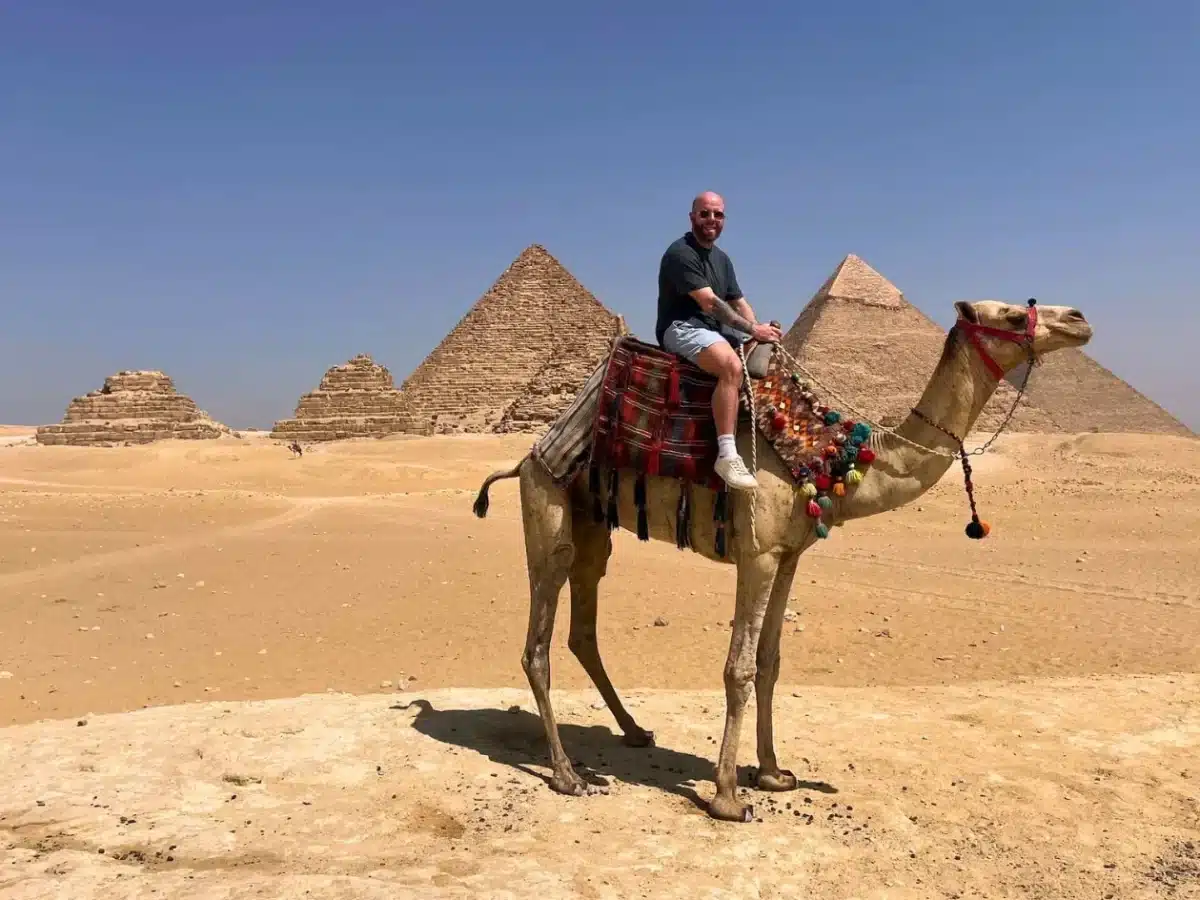
- Day one belongs to Giza. Arrive at the plateau before 7:30 am on a weekday, and you will have twenty minutes where the most photographed structures in human history are nearly empty. The Great Pyramid at close range is not what photographs prepare you for — it is the scale of the individual limestone blocks, each one the height of your waist, stacked four hundred and eighty feet into the sky. Stand there alone with that fact and let it settle.
- Book a private guide for Giza if you can — not because you cannot navigate it yourself, but because the site is large, the context is dense, and the vendors are persistent. A good guide handles both the history and the human noise simultaneously. If your budget is tight, visit the Egyptian Museum or the Grand Egyptian Museum instead, where you can go entirely at your own pace with the English signage alone.
- Day two: Islamic Cairo. The medieval city that most tourists skip is one that they are tired of. Do not skip it. Al-Azhar Mosque, the Citadel with its Alabaster Mosque of Muhammad Ali, and the Khan el-Khalili bazaar are within walking distance of each other and collectively more interesting than most of what is sold in guidebooks. Eat lunch at a local fuul and ta’meya spot rather than a tourist restaurant — ask your hotel to point you to theirs.
- Day three: the Grand Egyptian Museum. It opened fully in 2025, and it is extraordinary. The Tutankhamun collection alone — all 5,000 objects, displayed together for the first time — takes three hours. Book your ticket online the night before. Go in the morning. Bring water.
👉 Discover the best of Egypt’s capital with our complete Cairo Travel Guide and start planning your trip today.
The Overnight Train South: How to Travel Egypt Like a Local
The overnight sleeper train from Cairo to Aswan — or Cairo to Luxor if you want to break the journey — is one of the best travel experiences in Egypt for solo visitors, and it costs a fraction of a domestic flight.
Book through the Egyptian National Railways website or through your hotel. The sleeper service (trains 85 and 86) is the one foreigners are officially permitted to book, though the rules on this have loosened in recent years. A first-class sleeper cabin costs roughly $40–60 and includes a small meal and a bunk. It is not luxurious by any measure, but the rocking rhythm of the train south through the Delta and into Upper Egypt, with the Nile occasionally flashing past the window in moonlight, is something you will not forget.
Solo travelers tend to find the dining car sociable. Bring snacks anyway.
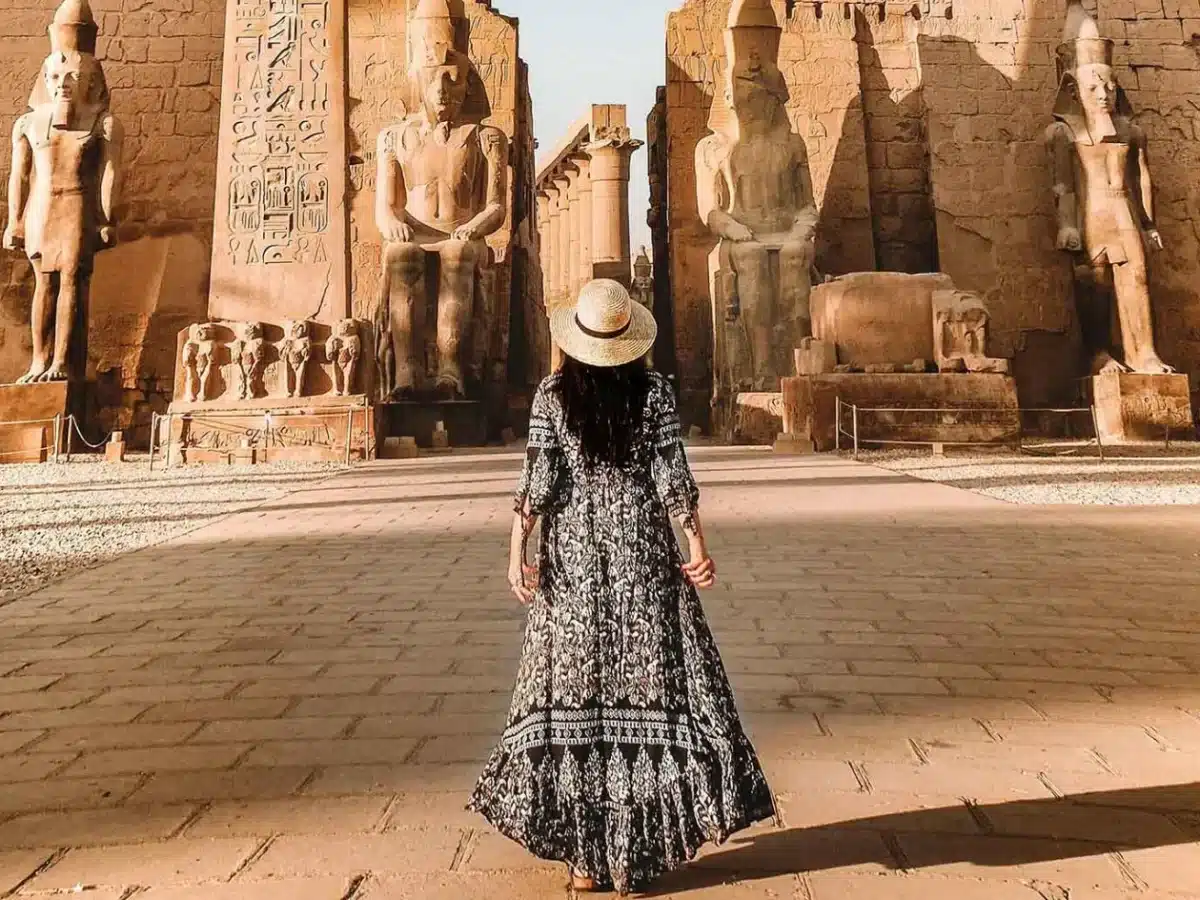
Luxor Alone: Walking Through History With No One to Rush You
Luxor is the best city in Egypt to visit as a solo traveler, and I say that as someone who was born near Cairo.
The reason is pace. Luxor is compact enough to navigate on a bicycle or tuk-tuk, unhurried enough that you can spend four hours in the Valley of the Kings and not feel like you are holding anyone up, and calm enough at dawn that you can sit on the east bank of the Nile with a glass of tea and watch the light come up over the Theban hills without anyone interrupting you.
- The Valley of the Kings, on your own, is a different experience from the one with a group. You can linger. You can go back into a tomb a second time. You can sit in the shade between tombs and read the story of Ramesses III without someone thirty feet away saying it is time to move on. The entry covers three tombs; the Tomb of Seti I is worth a separate ticket.
- Karnak Temple at dawn — before the tour buses arrive, before 8 am — is something I recommend to every solo traveler I meet. The scale of the hypostyle hall, 134 columns rising 21 meters, with horizontal light cutting through them at a low angle, is the closest thing to a religious experience that a stone building can offer. Go alone. Go early.
Solo traveler note: Luxor has good hostel options on the west bank, where solo travelers cluster naturally. If you want company, you will find it. If you want solitude, it is equally available.
Aswan and the Nile: Where Egypt Slows Down and So Will You
Aswan is where the Nile stops being a backdrop and becomes the entire point.
The city sits at a wide bend in the river where the water slows and spreads around granite islands and Nile feluccas — traditional wooden sailboats — drift past in the afternoons as if they have no particular destination in mind. If Cairo is Egypt’s nervous system and Luxor is its memory, Aswan is its exhale.
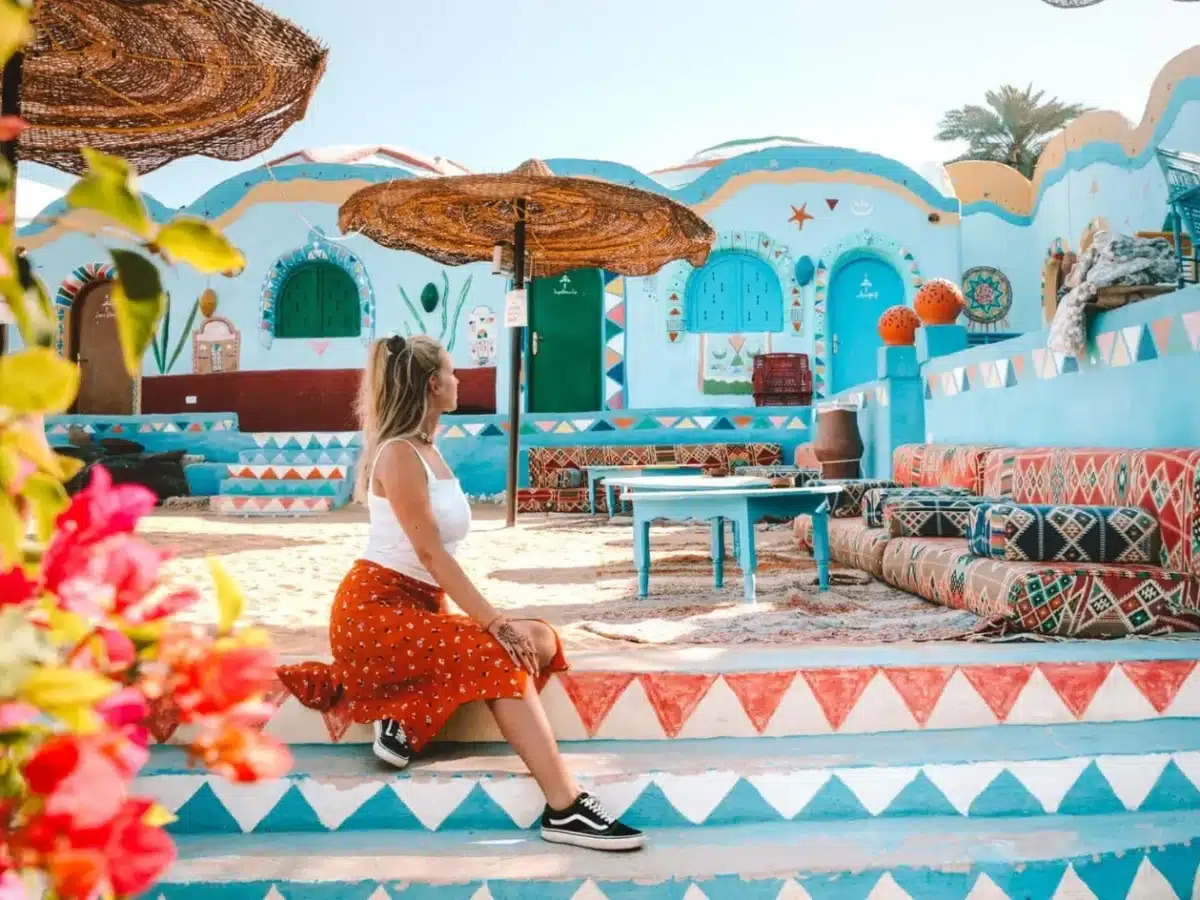
Solo travelers do well in Aswan because the city has a built-in social infrastructure. Felucca trips — typically two to three hours, often shared among whoever wants to join at the dock — put strangers together naturally. The Nubian village on Elephantine Island, accessible by local ferry for a few pounds, offers community dinners that solo visitors can book through guesthouses. These evenings — sitting on a Nubian rooftop with other travelers, eating slow-cooked ful and grilled fish, watching the stars above the Sahara — tend to be the memory people mention when they get home.
- Do not leave Aswan without: a boat to Philae Temple (accessible only by water, and worth every minute), an evening at the Aswan souk (smaller and less pushy than Khan el-Khalili), and at least one sunset on a felucca.
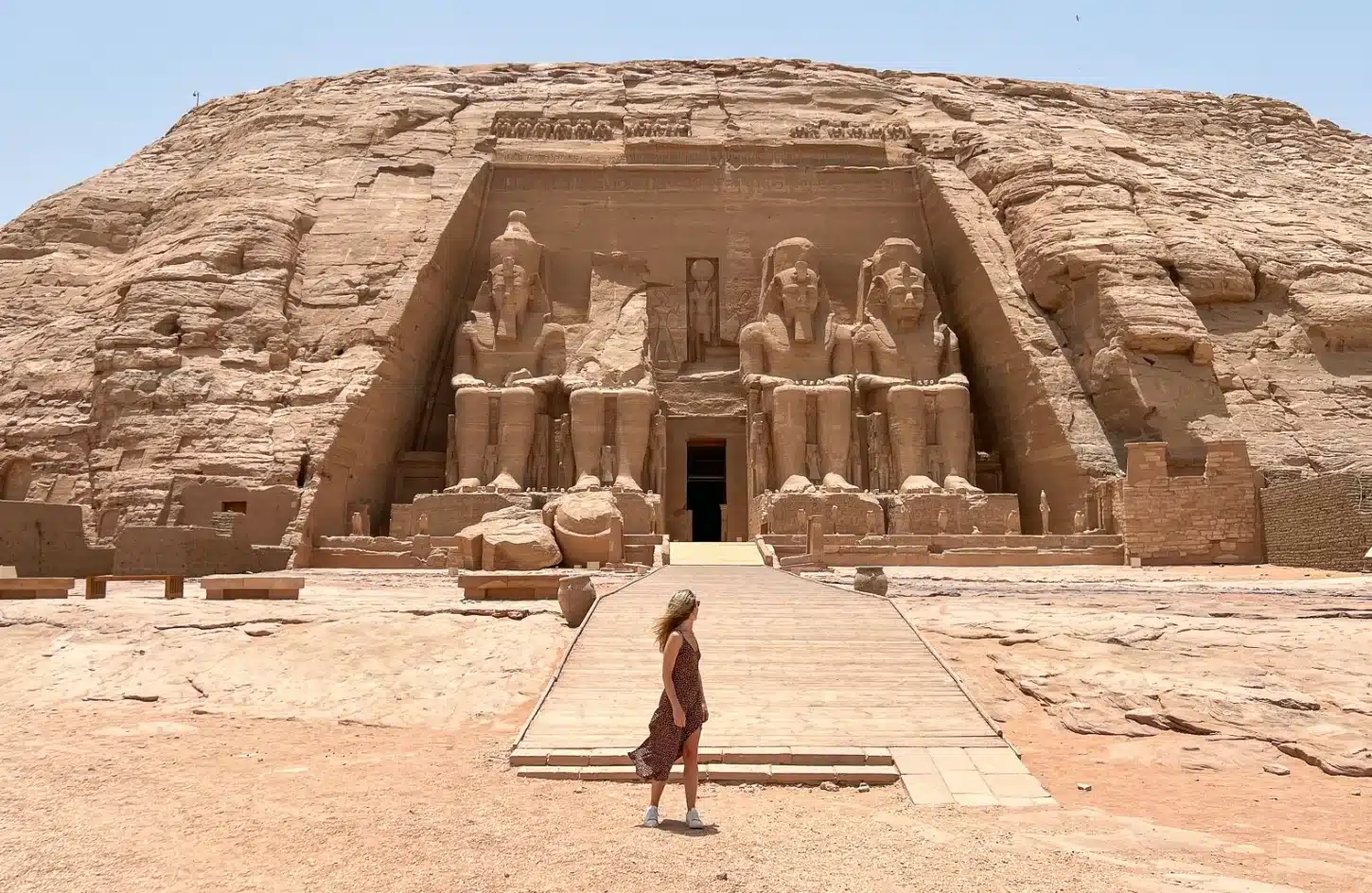
- Abu Simbel day trip: The two temples of Ramesses II, 280km south of Aswan, are accessible by an early-morning convoy drive or a short domestic flight. Solo travelers typically join a shared minibus from Aswan — ask your hotel to arrange it the night before.
Optional Escape Routes: Dahab, White Desert, Alexandria
- Dahab, on the Sinai’s southeast coast, is Egypt’s most relaxed destination and genuinely designed for independent travelers. The diving is world-class (the Blue Hole is one of the most famous dive sites on earth). The vibe is somewhere between backpacker and bohemian. Solo travelers in their twenties and thirties tend to stay longer than planned.
- The White Desert, a day’s drive west of Cairo, is for the solo traveler who wants genuine remoteness. The landscape — chalk rock formations sculpted by millennia of wind into shapes that look like mushrooms, camels, and abstract sculptures — is unlike anything else in Egypt. One, two, or three nights camping here, arranged through an operator in Bahariya Oasis, is extraordinary.
- Alexandria is a different Egypt entirely: Mediterranean, melancholy, literary. The city feels European in its bones — wide corniche boulevards, Greek-inflected architecture, a seafood culture that has nothing to do with the Nile. Alexandria day trip from Cairo (two hours by train) or an overnight. Better in October through March when the heat is gone.
Getting Around Egypt Alone: The Transport Guide Your Guidebook Forgot
Careem, Uber, or Taxi? Navigating Egypt’s Streets Without Getting Ripped Off
Both Careem and Uber operate in Cairo, Alexandria, Luxor, and Aswan. Use them. The price is fixed before you confirm the ride, the driver’s name and plate are visible, and the route is tracked. For solo travelers — especially women traveling alone at night — this is not optional convenience, it is basic sense.
Street taxis in Cairo still exist, and some solo travelers prefer them for short hops. If you use one, agree on the fare before you get in. Ask at your hotel reception what a fair price is for your route. The most common overcharge scenario in Egypt involves tourists who did not ask and then argue at the destination — an unpleasant exchange that is entirely avoidable.
Tuk-tuks are available in Luxor and Aswan for local travel and are cheap, cheerful, and completely unmetered. Bargain. A short trip should cost 15–30 Egyptian pounds. Starting at half what they quote and meeting in the middle is the expected process, and nobody is offended by it.
Trains, Buses, and Domestic Flights: The Egyptian Long-Distance Toolkit
| Transport | Route | Approx. Cost | Best For | Book Via |
|---|---|---|---|---|
| Sleeper train | Cairo → Luxor/Aswan | $40–60 | Atmosphere + overnight saving | Time-saving, less experienced |
| Day train | Cairo → Alex | $5–10 | Budget, comfortable enough | Station counter |
| Bus (GoBus) | Cairo → Hurghada / Dahab | $10–20 | Budget, air-conditioned | GoBus app |
| Domestic flight | Cairo → Aswan / Luxor | $40–90 | Time-saving, less experienced | Nile Air, EgyptAir |
| Shared minibus | Aswan → Abu Simbel | $15–25 | Abu Simbel day trip | ENR website/hotel |
The practical rule: if the journey is under five hours and overnight, take the train. If it is over six hours or you are crossing between very different regions (e.g., Cairo to Sharm el-Sheikh), fly. Buses are reliable for the Red Sea coast, but the roads between Cairo and Sinai are long.
Money, Scams, and Baksheesh: The Honest Financial Reality of Solo Egypt Travel
What Solo Travel in Egypt Actually Costs: Budget, Mid-Range, and Splurge Breakdowns
Egypt is genuinely affordable by international standards, but “affordable” covers a wide range depending on how you travel.
| Category | Budget Traveler | Mid-Range | Splurge |
|---|---|---|---|
| Accommodation (per night) | $10–20 (hostel dorm) | $35–70 (3-star hotel) | $100–250 (boutique / 5-star) |
| Food (per day) | $5–12 (street food + local restaurants) | $15–30 (mid restaurants + one tourist dinner) | $40–80 (hotel dining, rooftop restaurants) |
| Transport (per day) | $3–8 (apps + trains) | $10–20 (private transfers + apps) | $30–60 (private car + driver) |
| Site entry (per day) | $10–20 | $25–50 | $50–100 (incl. premium access) |
| Total daily estimate | $28–60 | $85–170 | $220–490 |
Entry fees at Egyptian sites are priced in USD for foreigners and have increased since 2023. Budget for roughly $25–30 per day if you are visiting a major site.
The single biggest variable in an Egypt solo travel budget is whether you hire guides. A licensed private Egyptologist guide for a full day costs $50–120, depending on the site and duration. It is not cheap in local terms. It is worth it at least once, particularly at Karnak, the Valley of the Kings, or the Grand Egyptian Museum.
The Scams Every Solo Traveler Encounters (and How to Sidestep Them Gracefully)
Every solo traveler in Egypt will encounter at least one of these. They are annoying. They are not dangerous. Knowing the script in advance makes them easy to deflect.
- The unsolicited guide. A man at the entrance to a temple falls into step with you, shares some genuinely interesting history, and then at the end asks for payment. You did not hire him, but now the social contract feels murky. Solution: In the first sentence, smile and say, “I’m fine on my own, thank you,” then continue walking. Do not engage with the history, however good it is. Once you engage, the contract is made.
- The papyrus gallery shortcut. A friendly local offers to show you a “local market” or “my cousin’s shop” as a favor. This is always a carpet or papyrus gallery with commission involved. Decline cheerfully. “I already have everything I need, thank you.”
- The camel/horse photo fee. At Giza, men with camels and horses will position themselves near you and invite you to take a photo. After the photo, they will quote you a price. The solution is not to take the photo unless you have agreed on a price first, or just photograph the pyramids, which are arguably more interesting.
- The fake ticket office. Near some sites, unofficial “helpers” will direct you to a window that looks like the ticket office but is not. Buy tickets only at the official booth, which is always clearly marked and never down an alley.
- Baksheesh and the art of the graceful exit. Baksheesh — small tips given to guards, bathroom attendants, people who “help” you without being asked — is woven into Egyptian social life. It is not a scam. It is a parallel economy that has functioned for centuries. Keep small notes (5–10 EGP) accessible in a front pocket rather than your wallet. Give them without making it a transaction. Refuse with a smile when it is truly unsolicited.
👉 Plan your trip wisely — discover the Best Time to Visit Egypt for perfect weather and fewer crowds.
Baksheesh, Tipping, and the Unwritten Social Contract of Egyptian Tourism
Tipping in Egypt is not optional, as it might be in Northern Europe. It is part of how the service economy functions, and the amounts involved — for travelers converting from stronger currencies — are genuinely small.
A general rule of thumb:
- Bathroom attendant: 5 EGP
- Hotel porter per bag: 20–30 EGP
- Restaurant (not included in bill): 10–15% of the total
- Day tour guide: $10–20 USD (cash, given directly, at the end of the day)
- Driver on a full day: $5–10 USD
Trying to opt out of tipping entirely causes more friction than it resolves. Budget roughly $5–10 USD per day for small tips, and carry it in local currency. See also our detailed guide to tipping on a Nile cruise for the specific etiquette once you are on board.
Eating, Connecting, and the Art of Being Alone Together in Egypt
What and Where to Eat When There’s No One to Share a Dish With
Solo dining in Egypt is, counterintuitively, one of the easiest things about the trip.
Egyptian food is built for eating alone or with crowds — it makes no difference. The food is served communally by instinct but ordered individually without any fuss. Sit down at a local restaurant, and the waiter will bring bread and a bowl of pickles without being asked. No one will look at you strangely for eating alone. If anything, you are more likely to end up in a conversation with the table next to yours.
The Foods to Seek out as a Solo Traveler in Egypt:
Kushari is Cairo’s unofficial dish — a bowl of rice, lentils, pasta, and fried onions topped with a sharp tomato-and-vinegar sauce. Order it at a kushari shop (they are everywhere in central Cairo) and eat it standing up or at a plastic table for 20–40 EGP. It is good.
Fuul and ta’meya — slow-cooked fava beans and Egyptian falafel — are the classic Egyptian breakfast. Find a place that opens at 7 am, order both, and add a glass of freshly squeezed guava juice. This breakfast costs under $2 and is one of the genuinely great things about being in Egypt.
Kofta and grilled meats at a local grill house in Luxor or Aswan, eaten slowly with flatbread and a tahini dip, make for the perfect solo dinner. Take the table outside if there is one.
👉 Discover the rich flavors of Egypt — explore 20 Amazing Traditional Egyptian Foods you must try on your next trip.
One specific recommendation: the ahwa (traditional Egyptian coffee house) culture is underused by foreign travelers. Sit down, order a cup of Turkish coffee or a glass of karkade (hibiscus tea), and watch the neighborhood go by. Nobody will rush you. Nobody will try to sell you anything. This is Egypt at its most honest.

How to Meet Other Travelers (Without Feeling Like You’re Trying Too Hard)
Solo travel in Egypt is not, in practice, very lonely — because the country’s social architecture pulls people together whether they intend it or not.
- Felucca rides in Aswan are the natural meeting point. Boats depart from the corniche in the late afternoon, carrying whoever shows up — solo travelers, couples, small groups. Two hours on the Nile with strangers who become temporary company is a very Egyptian experience.
- Hostels on Luxor’s west bank — Marsam Hotel and Nefertiti are the two with the best reputations among independent travelers — have a communal dinner culture in which solo guests naturally end up at the same table.
- Dahab’s dive schools are magnets for solo travelers. Sign up for a discovery dive or a PADI course, and you will spend three days with a small group of international travelers in one of the most beautiful underwater environments on earth.
- Shared minibus trips — to Abu Simbel from Aswan, to the White Desert from Cairo — reliably put together six to eight strangers who spend a day in the same van and often end up having dinner together at the other end.
The one place you will not accidentally make friends is on a private tour. That is the trade-off of going fully solo and independent. If connection matters to you, build in at least one shared experience.
Packing for Egypt Solo: Light, Smart, and Ready for Anything
The Egypt Solo Packing List (From Someone Who Learned What Not to Bring)
I have watched thousands of travelers arrive in Egypt with suitcases that seem to contain entire wardrobes, and leave having worn 30% of them. Egypt’s climate — hot and dry for most of the year, mild in winter — does not require much. What it requires, it requires specifically.
Clothing:
- 3–4 lightweight, breathable shirts or tops (linen or moisture-wicking fabric)
- 1–2 pairs of lightweight trousers or long skirts (women: doubles as modesty layer for mosques and local areas)
- 1 pair of shorts or lightweight dress (for Nile cruise decks and Red Sea coast only)
- A light scarf or pashmina — use for sun protection, mosque visits, and cold bus air conditioning
- Comfortable walking shoes and one pair of sandals for the Nile cruise decks
- A light fleece or layer for winter months (November–February) or heavily air-conditioned transport
Tech and practical:
- Careem app was installed before arrival
- Maps.me with Egypt offline map downloaded (essential for Islamic Cairo and when data is patchy near sites)
- VPN app (some services are restricted in Egypt)
- Portable charger — long days in the heat drain phones fast
- A money belt or internal zip pocket for your passport and cash in crowded markets
- Small torch or phone torch for tomb interiors (lighting inside some Valley of the Kings tombs is dim)
What to leave at home:
- Anything you would be upset to lose. The markets are full of replica antiquities if you need to acquire something.
- Multiple cameras and expensive equipment in crowded areas. One camera or a good phone is enough.
👉 Travel smarter and stress-free — check our complete guide on What to Pack for a Trip to the Middle East before you go.
Ready to Write Your Own Egypt Chapter? Here’s How EgyVacations Helps You Travel Alone, Not Lonely
Solo travel in Egypt is not especially complicated. The route is clear, the infrastructure works, the people are warm, and the sights are, genuinely, among the greatest things human beings have ever built. You do not need a tour group to navigate it.
What a tour group — or more precisely, a good local guide — gives you is context. The difference between walking through Karnak alone with a map and walking through it with someone who can tell you which pharaoh built which hall, why the hypostyle columns are painted in those specific colors, and where to stand at 8:15 am so the light falls exactly right, is not a small difference. It is the difference between observing history and understanding it.
At EgyVacations, we work with solo travelers differently from the standard package model. There is no minimum group size, no fixed departure date, and no itinerary you did not choose. You tell us how many days you have, what you want to see, and how you like to travel — independently most of the time, with a guide when it matters — and we build around that.
Our guides are Egyptian. They speak the language, they know the site guards by name, they know which ticket counter has the shortest queue on a Tuesday morning, and they know the good fuul place near the Valley of the Kings that no guidebook has ever listed.
If you want to plan your solo trip to Egypt — whether it is ten days or three weeks, Cairo only or the full circuit south — get in touch. There is no obligation and no sales pressure. Just an Egyptian who wants your trip to be excellent.
Frequently Asked Questions About Solo Travel to Egypt
Is Egypt safe for solo travelers in 2026?
Yes. Egypt’s main tourist destinations — Cairo, Luxor, Aswan, Hurghada, Dahab, and Alexandria — have dedicated tourist police, solid independent travel infrastructure, and a local culture that is generally protective toward foreign visitors. The risks you will actually encounter are social rather than physical: persistent vendors, occasional overcharging, and minor scams around major sites. Northern Sinai is the one region most governments advise against visiting; everywhere else on the tourist circuit is open and safe. Solo women should read the preparation section above before arriving.
How much does solo travel in Egypt cost per day?
Budget travelers — hostel dorms, local street food, app-based taxis — can get through a day in Cairo or Luxor for $30–60, including site entry. Mid-range travelers spending on a private room, one restaurant dinner, and occasional guided experiences will pay $85–170. Entry fees at major archaeological sites are priced in USD for foreigners and have risen since 2023; budget $25–30 per day for sites alone. The biggest variable is private guides, which run $50–120 per day.
What is the best itinerary for a solo trip to Egypt?
For ten days, the Cairo–Luxor–Aswan route covers the essentials without feeling rushed. Three days in Cairo for the Giza plateau and the Grand Egyptian Museum, then Islamic Cairo. Overnight train south to Luxor for three days: Valley of the Kings, Karnak at dawn, Luxor Museum. Two days in Aswan for Philae Temple, a felucca sunset, and Abu Simbel as a day trip. Dahab on the Sinai coast is the best extension for travelers with more time.
Do I need a guide to travel to Egypt alone?
No — English signage, app-based transport, and solid tourist infrastructure make independent travel straightforward. That said, a local guide for one or two days at the right sites — Karnak, the Valley of the Kings, the Grand Egyptian Museum — makes a genuine difference. The context of these places is not in the signage. At EgyVacations, we arrange guides for individual days rather than whole trips, which most solo travelers find to be the right balance.
Can I use Uber or Careem in Egypt?
Yes. Both operate in Cairo, Alexandria, Luxor, and Aswan. Download both before you arrive — Careem tends to have more drivers in Upper Egypt cities. Fixed pricing before you confirm and a tracked route make app-based taxis the sensible default, particularly for solo women traveling at night. In Luxor and Aswan, tuk-tuks cover short local trips for 15–30 EGP; expect to negotiate.
Is Egypt a good destination for solo travel if I don’t speak Arabic?
Very. English is spoken at all major sites, most hotels, and tourist-facing restaurants. Careem and Uber remove the biggest friction point for non-Arabic speakers — taxi fare negotiation. Three phrases cover most situations: “la shukran” (no, thank you) and “bikam?” (how much?), and “shukran” (thank you). Google Translate’s camera function handles menus and signs adequately. Arabic matters more if you venture well off the tourist circuit, but on the Cairo–Luxor–Aswan route, you will not be stuck.
