
Quick answer
Abu Simbel is a pair of rock-cut temples Ramesses II built around 1264–1244 BCE on the shore of Lake Nasser, about 280 km south of Aswan. Four colossal statues, each about 20 meters tall, guard the Great Temple; the smaller temple honors Queen Nefertari and the goddess Hathor. Fly from Aswan (about 45 minutes) or drive (3.5–4 hours). Foreign adult tickets run roughly EGP 750–820, and about EGP 1,200 on Sun Festival days: 22 February and 22 October. Allow 1.5–2 hours on site.
No photo can really prepare you for Abu Simbel. You come across the open desert, over a huge artificial lake and then the four seated figures of the same king appear in the cliff face, each as tall as a six story building. A corridor of painted walls, some 60m long, runs into the mountain to a sanctuary where, on two mornings each year, the rising sun actually reaches the statues in the dark.
This guide covers what the temples are, how they were saved from drowning, how to get there from Aswan, ticket costs, how the Sun Festival works, and how to decide between a day trip and an overnight stay. We run private tours and Nile cruises that include Abu Simbel every week, so the practical advice reflects what works on the ground.
Abu Simbel at a Glance
| Fact | Details |
|---|---|
| Built | c. 1264–1244 BCE, reign of Ramesses II (19th Dynasty) |
| Location | West bank of Lake Nasser, about 280 km south of Aswan, close to the Sudanese border |
| Two Temples | The Great Temple of Ramesses II, and the Small Temple of Nefertari and Hathor |
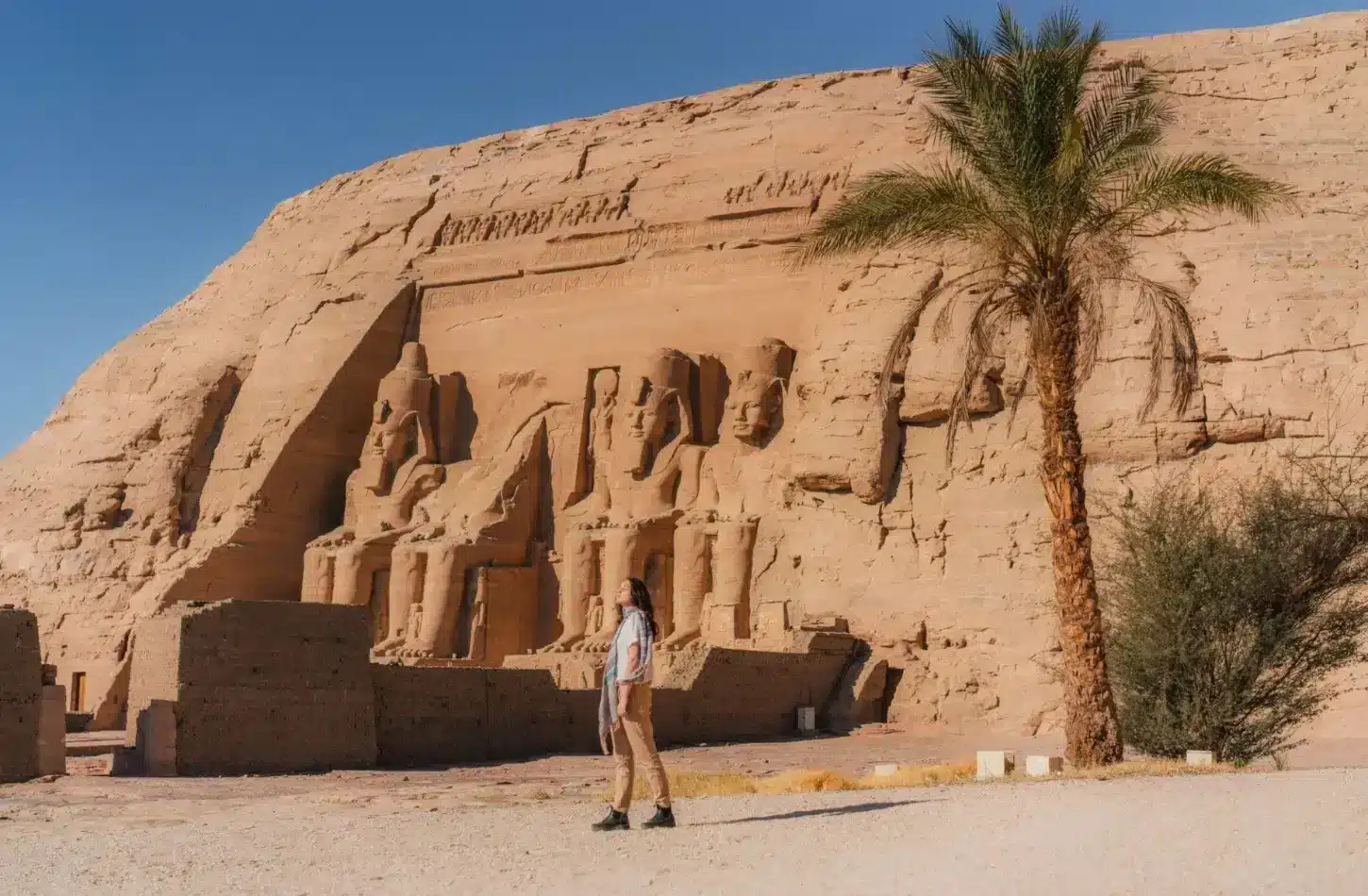
| Great Temple Facade | Four seated colossi of Ramesses II, about 20 m high; the temple runs roughly 60+ m into the rock |
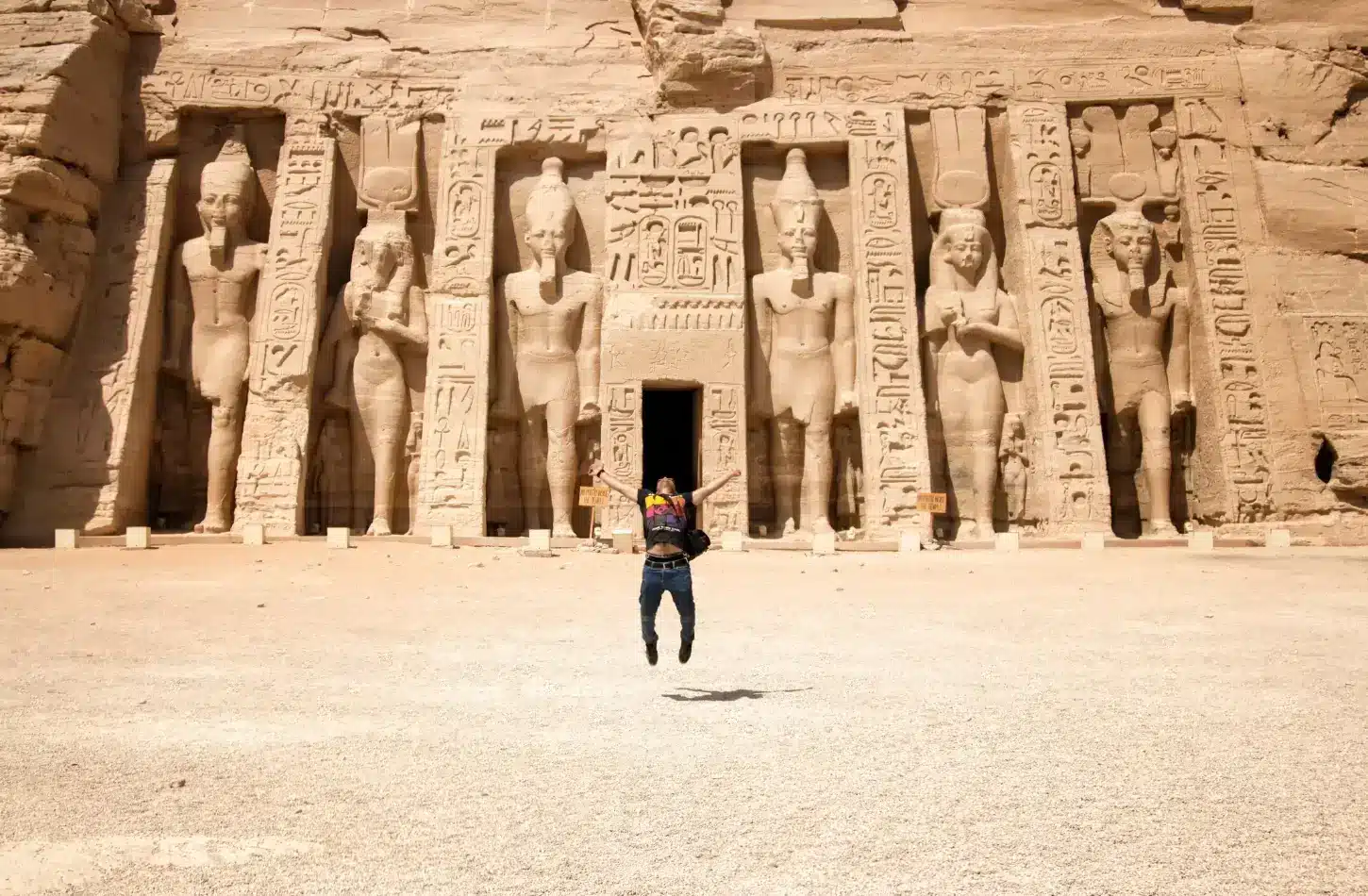
| Small Temple Facade | Six standing statues about 10 m high: four of Ramesses II, two of Nefertari |
| Rediscovery | Found by Johann Ludwig Burckhardt in 1813; first entered by Giovanni Belzoni in 1817 |
| Relocation | 1964–1968: moved about 65 m higher and 200 m back from the river to escape Lake Nasser |
| UNESCO Status | Part of the Nubian Monuments from Abu Simbel to Philae (World Heritage, 1979) |
| Sun Festival | 22 February and 22 October each year (next: Monday 22 February 2027 and Friday 22 October 2027) |
| Getting There | Flight from Aswan about 45 min; road 3.5–4 hours each way |
| Time on Site | 1.5–2 hours for both temples with a guide; 30–45 minutes for the Small Temple |
| Tickets (Foreign Adult) | Roughly EGP 750–820 normally; about EGP 1,200 on Sun Festival days (sources differ slightly; confirm before travel) |
Why Abu Simbel Matters
Ramesses II ruled Egypt for 66 years and built more than any other pharaoh. Abu Simbel was his message to the south: carved at the border with Nubia, it announced to anyone sailing north from Africa exactly who ruled Egypt. The facade alone works as propaganda. Four identical colossi of the king, a frieze of baboons above the doorway greeting the sun, and small figures of his queen, mother, and children at his feet.
The temple is also an engineering feat. The architects cut it into a sandstone cliff and aligned the axis so that the sun would reach the innermost chamber twice a year. Then, 3,200 years later, engineers cut it out of the cliff and moved it to save it from the water behind the Aswan High Dam. Few monuments have two such stories.
The Great Temple of Ramesses II
The Facade
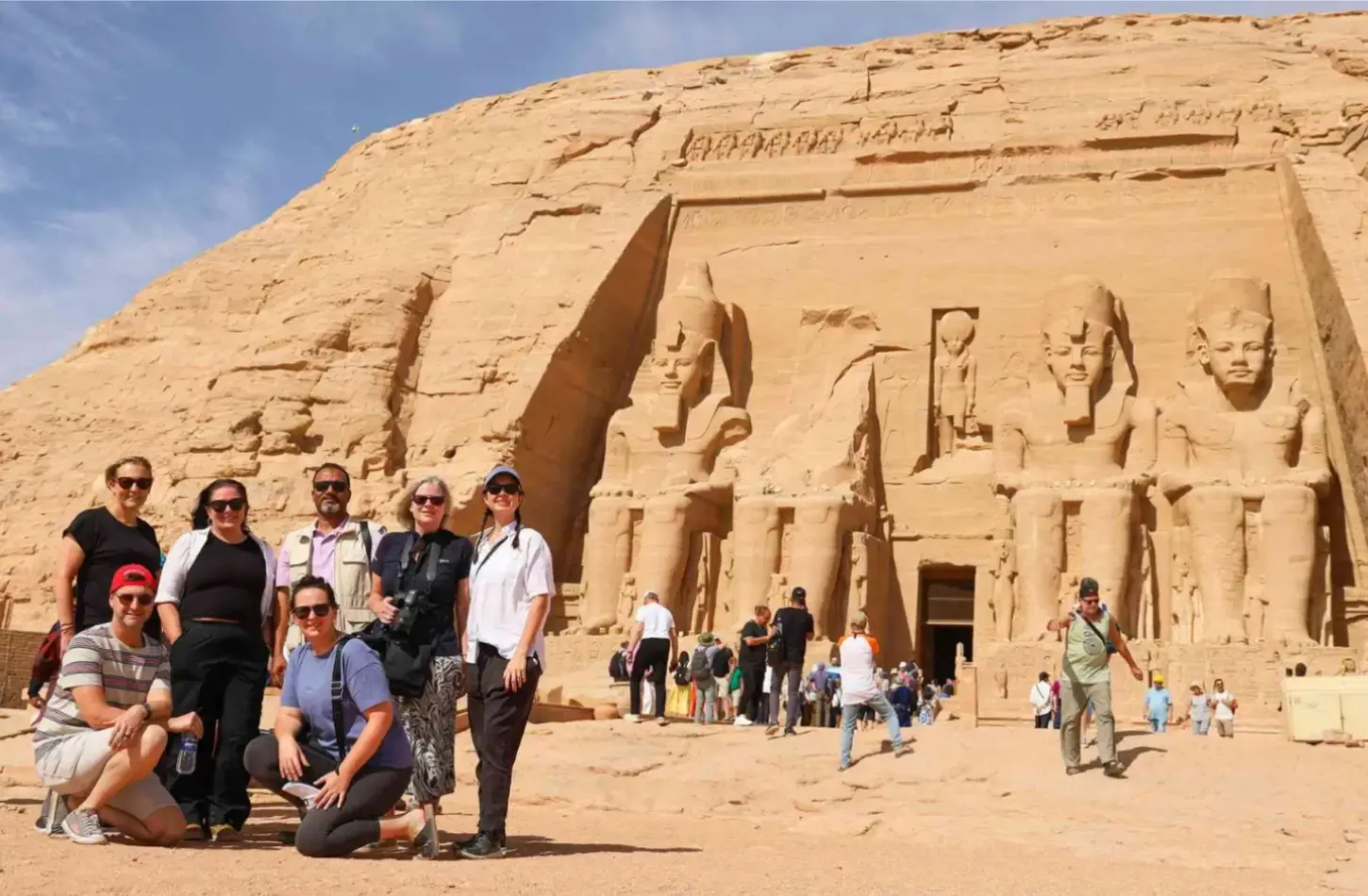
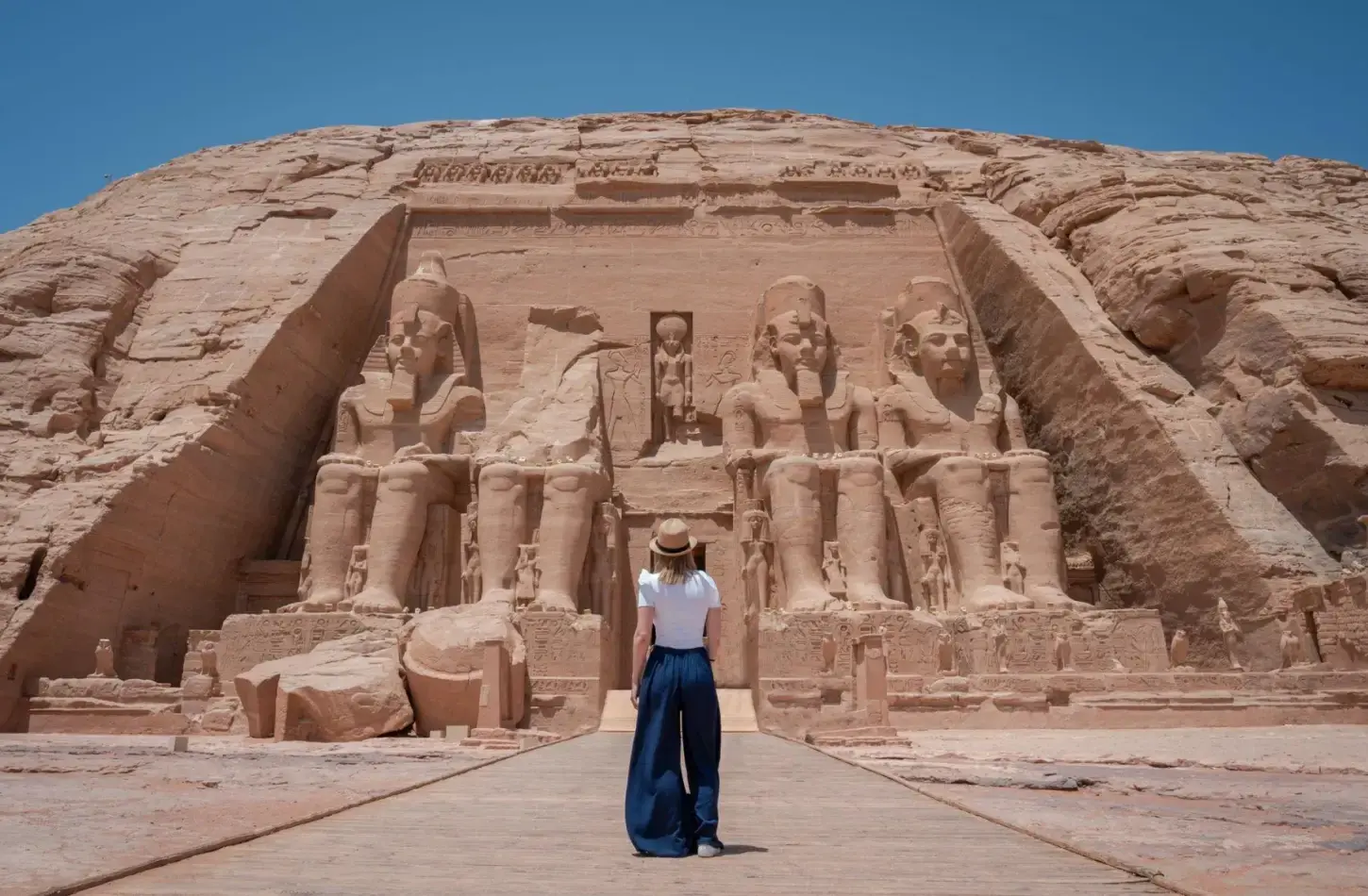
The four colossi stand side by side, each about 20m tall. The second one from the left fell in antiquity (very likely as a result of an earthquake not long after the temple was completed) and its head and upper body still lie at its feet. A figure of Ra-Horakhty stands above the doorway and a row of baboons is depicted on the cornice all raising their arms to the sunrise.
The Great Hall
Step inside and the scale is completely different. The first hall is full of eight pillars, each one fronted by a statue of Ramesses II as Osiris. The walls are all covered in relief. The most famous of these is the Battle of Kadesh on the north wall (a battle Ramesses had claimed as a great victory) with Ramesses in his chariot, the enemy chariots fleeing and the Hittite camp in all its detail. There are also scenes of him presenting captives to the gods, the usual royal theology.
The Sanctuary
At the back, some 60m from the entrance, the sanctuary contains four seated statues: Ptah (god of darkness and of creation), Amun-Ra, the deified Ramesses II and Ra-Horakhty. On two days a year the rising sun will reach this room and illuminate three of the statues. Ptah is at the far end in shadow and by design the sun will not reach him.
The Small Temple of Nefertari and Hathor
Many people give this temple ten minutes after the Great Temple. It quite rightly deserves 30–45. It’s dedicated to the goddess Hathor and to Ramesses’ principal queen Nefertari. It’s one of the very few temples in Egypt where the queen is shown on the facade as the equal of the king in scale (six statues in total, four of Ramesses and two of Nefertari, all about 10m high).
Inside the carved scenes show Nefertari being honoured by Hathor and being crowned by Isis and Hathor. It’s quieter, more intimate and more delicate than the Great Temple and a very good contrast to it.
The Great Rescue: How Abu Simbel Was Moved
When the Aswan High Dam was approved in the 1950s, it was clear that the rising waters of Lake Nasser would submerge the Nubian temples (including Abu Simbel). In 1959, Egypt and Sudan approached UNESCO, and the ensuing international campaign was one of the great cooperative rescues of cultural heritage.
- 1964 to 1968: the engineers took the two temples out of the cliff in over a thousand blocks and re-erected them on a plateau some 65m higher and 200m back from the river.
- The rebuilt temples sit against a man-made concrete dome that reproduces the original cliff profile
- Dozens of countries contributed funds and expertise, and the project cost tens of millions of dollars
- The move has shifted the sun alignment by a day. The festival now falls on 22nd February and 22nd October (a day later than it did previously).
The joins are virtually invisible to the visitor. You’re in a genuine temple, but not in the original location. That’s the paradox at the heart of Abu Simbel and one of the very good reasons for including the story in your guide’s intro.
The Abu Simbel Sun Festival: 22 February and 22 October
What Happens
Twice a year (22nd February and 22nd October) the rising sun enters through the temple doorway and travels the full length of the corridor to the sanctuary, illuminating the statues of Ra-Horakhty, Ramesses II and Amun-Ra for around 20 minutes. Ptah remains in shadow. The dates are traditionally associated with the coronation and birthday of Ramesses, though this is disputed by scholars as to how intentional the selection was.
What It Is Really Like
It’s a spectacle really, and a crowd event. You’ve got thousands of people queuing up before dawn, musicians and dancers outside and the sanctuary is absolutely full. If you’re after astronomy and the atmosphere then it’s absolutely worth it. If you’re after a quiet day to just study the carvings then you’d be better off on a normal day.
October is also an excellent month for exploring Upper Egypt and experiencing the Abu Simbel Sun Festival. Read our guide to visiting Egypt in October to learn more about the weather, seasonal events, and travel conditions.
| Factor | Sun Festival Day (22 Feb / 22 Oct) | Ordinary Day |
|---|---|---|
| Crowds | Very high; queues from before dawn | Moderate; quietest early morning and late afternoon |
| Tickets | About EGP 1,200 foreign adult (roughly 60% above normal) | About EGP 750–820 foreign adult |
| Accommodation | Aswan and Abu Simbel fill months ahead | Easy to book |
| Time Inside the Sanctuary | Short; timed and controlled | Relaxed; ask your guide to linger |
| Best For | Astronomy, photography of the alignment, atmosphere | Carvings, scale, a calmer visit |
February vs October
- February: cooler weather, better for a long day on foot, and it fits naturally into a winter Nile cruise
- October: warmer, with Upper Egypt still hot by day; it pairs well with a late-autumn cruise
- Both dates draw similar crowds. The next two are Monday 22 February 2027 and Friday 22 October 2027
Plan Early If The Sun Festival Matters
Hotels in Aswan and Abu Simbel and flights on the festival mornings fill very early. If you want to be there, decide your dates first and book accommodation, flights and a guide as far ahead as possible. Last-minute availability on 22 February or 22 October is limited and expensive.
How to Get to Abu Simbel from Aswan
| Option | Journey | Best For | Notes |
|---|---|---|---|
| Flight from Aswan (day trip) | About 45 min each way | Most visitors; limited time | Fastest option; most day trips are back in Aswan by early afternoon |
| Road from Aswan | 3.5–4 hours each way | Budget; people who enjoy desert drives | Long day; the road has traditionally run in an early-morning convoy, so confirm current arrangements |
| Overnight at Abu Simbel | Fly or drive in the day before | Sun Festival; sunset light; a quiet first-hour visit | Few hotels, so book early; you also see the temples at sunset |
| Lake Nasser cruise | 3–5 nights | Slow travel; repeat visitors | Ships stop at Kalabsha, Wadi es-Sebua, Amada and Qasr Ibrim before Abu Simbel |
| Private tour from Aswan | Customised | Families, photographers, honeymooners | Egyptologist guide and private vehicle; flexible timing |
Many travelers choose to visit Abu Simbel as part of their journey along the Nile. Explore our Egypt Nile River Cruises to discover itineraries connecting Luxor and Aswan with opportunities to visit some of Egypt’s most remarkable ancient monuments.
Egyvacations Tip: Why We Recommend Basing In Aswan
Flying from Cairo to Aswan and on to Abu Simbel in a single day is technically possible but exhausting. Most travelers enjoy Abu Simbel far more if they sleep at least one night in Aswan first. That also lets you pair it with Philae Temple and a Nubian village visit, and it puts you in the right place for the early start.
Abu Simbel Tickets and Opening Hours (2026)
| Ticket | Foreign Adult | Foreign Student (with ID) | Notes |
|---|---|---|---|
| Standard Entry | Roughly EGP 750–820 | About half the adult price | Covers both temples; sources report slightly different figures |
| Sun Festival Day (22 Feb / 22 Oct) | About EGP 1,200 (reports up to about EGP 1,270) | About EGP 600 | Special pricing on the two festival dates |
| Egyptian Adult | Much lower; resident rate | — | Requires ID |
Opening hours run from early morning to late afternoon and vary by season, so check the Ministry of Tourism and Antiquities or your operator for the current times before you travel. Prices change periodically: confirm the figure on the day you book.
Tickets Are Usually Included In Tours
On a guided tour, the entrance fee is normally part of the price, but not always, especially on cruises and day-trip add-ons. Always ask: Are the Abu Simbel entrance fees included, and are the flights included?
Best Time to Visit Abu Simbel
Best Time of Year
- October to April: comfortable temperatures. Winter days at Abu Simbel are pleasant, though dawn can be cold
- May to September: hot. It can be over 40C in the far south by midday if you go. If you go, go in the early morning and get the hell out by late morning.
Best Time of Day
- First thing in the morning when the light is soft on the facade and the first flights haven’t even arrived yet: that’s absolutely the best way to experience Abu Simbel.
- Late afternoon, if you overnight: tour groups have left and the stone turns gold
- Avoid the middle of the day in summer
How Long to Allow
- Great Temple: 45–60 minutes inside plus time at the facade
- Small Temple: 30–45 minutes
- Allow 1.5–2 hours in total with a guide, not including travel
If you’re planning to explore more of the country, check out our guide to the best time to visit Egypt, with seasonal weather information and recommendations for visiting destinations such as Aswan, Luxor, and Abu Simbel.
Tips for Visiting Abu Simbel
- Start early. Whether you fly or drive, the first slot is the best slot
- Dress for the sun. Hat, sunglasses, sunscreen, and modest, breathable clothing; add a warm layer for winter dawn starts
- Carry water. Facilities at the site are limited
- Hire an Egyptologist. The facade on its own is quite impressive, the Kadesh reliefs and the symbolism of the sanctuary only really make sense with an explanation.
- Check the interior photography rules on the day. Flash is not permitted and the rules regarding cameras and tripods have changed at various times in the past so it’s worth asking your guide.
- Book flights and festival-day accommodation early
- Carry your passport. Some checkpoints on the road require it
For more practical information before your journey, read our Egypt travel advice guide, covering transportation, local customs, money, safety, and other useful tips to help you prepare for your visit.
Combining Abu Simbel with the Rest of Your Egypt Trip
| Trip | How Abu Simbel Fits |
|---|---|
| Cairo + Nile Cruise (8 days) | Take a day trip from Aswan before or after the cruise, by early-morning flight |
| Winter Nile Cruise | Time your cruise to reach Aswan around 22 February to catch the Sun Festival |
| Autumn Nile Cruise | Time your cruise to reach Aswan around 22 October |
| Private Egypt Tour | Add a night at Abu Simbel for the sunset and a quiet first-hour visit |
| Luxor and Aswan Only | Fly Luxor–Aswan, add Philae and Abu Simbel on consecutive days |
Most visitors reach Aswan at the end of a Nile cruise from Luxor, which makes Abu Simbel a natural final day. It rounds off the story: the pyramids of the Old Kingdom, the temples and tombs of Thebes, then the greatest monument of the pharaoh who ruled longer than any other.
If you want to combine Abu Simbel with Cairo, Luxor, and Aswan, explore our Egypt vacation packages for multi-day itineraries that bring together the country’s most famous historical attractions.
Visit Abu Simbel with EgyVacations
EgyVacations is a licensed Egyptian tour operator running private tours, Nile cruises and multi-country trips (all with their own guides and vehicles). Just let us know your dates and whether you’re after a day trip, an overnight or the Sun Festival and we’ll send you a private itinerary with the full price.
- Day trip from Aswan with Egyptologist guide and transfers
- Overnight at Abu Simbel for sunset and a quiet first-hour visit
- Sun Festival trips (22 February and 22 October): limited, so book as early as possible
- Nile cruise packages that end in Aswan, with Abu Simbel as a final-day extension
- Private, customized itineraries for families, photographers and honeymooners
From ancient temples and archaeological sites to unforgettable Nile journeys, discover our Egypt tours and find an itinerary that matches your travel interests and schedule.
Frequently Asked Questions
What are the Abu Simbel temples?
Abu Simbel is a complex of two rock-cut temples dating from the time of Ramesses II (c. 1264-1244 BC) on the western bank of Lake Nasser in southern Egypt. The Great Temple is fronted by four massive seated statues of the pharaoh (each c. 20m high). The smaller temple is dedicated to Hathor and to Queen Nefertari. Both temples were relocated in the 1960s to prevent them being submerged by Lake Nasser.
How do I get from Aswan to Abu Simbel?
The quickest way is a flight of around 45 minutes (usually as part of a day trip which returns to Aswan in the early afternoon). The road trip takes 3.5 to 4 hours each way and has traditionally been a morning convoy. You can of course stay overnight in Abu Simbel or arrive by Lake Nasser cruise.
What will it cost to visit Abu Simbel in 2026?
Foreign adult tickets are normally in the region of EGP 750–820 (around half that for students with ID) and EGP 1,200 on the two Sun Festival days (22nd February and 22nd October). Different sources give slightly different figures and the prices do change from time to time so it’s always worth checking with the MoTA or your operator to confirm the current rate.
When is the Abu Simbel Sun Festival?
On 22nd February and 22nd October each year (when the rising sun is in the inner sanctuary and lights three of the four statues for about 20 minutes) and the dates are one day later than they were prior to the temples being moved in the 1960s. The next two will be Monday 22nd February 2027 and Friday 22nd October 2027.
How long should I be at Abu Simbel?
Allow 1.5 to 2 hours for both temples with a guide (approx 45 to 60 minutes in the Great Temple and 30 to 45 minutes in the Small Temple of Nefertari). A lot of people rush the smaller temple and that’s a mistake.
Is Abu Simbel worth it?
Yes it’s one of the most memorable sites for the vast majority of visitors. The sheer scale, the isolation on Lake Nasser and the story of the UNESCO rescue combine to make it something that the temples at Luxor simply can’t match. If you’re only going to do one extension off the Nile cruise route then Abu Simbel should be it.

Written by
Yasser Shoaib
Operations Manager, EgyVacations
Yasser Shoaib is an Egyptian tour guide, travel expert, and Operations Manager at EgyVacations, with more than 15 years of experience in Egypt’s tourism industry. Specializing in cultural tours, Nile River cruises, and tailor-made travel experiences, Yasser combines operational expertise with firsthand knowledge of Egypt’s most remarkable destinations. Over the years, he has guided travelers through world-famous landmarks, including the Great Pyramid of Giza and the Valley of the Kings, offering valuable insights into Egyptian history, culture, and local travel experiences. As a content writer and travel expert, Yasser shares practical advice, insider tips, and detailed knowledge of destinations to help travelers plan memorable, seamless journeys across Egypt.